You must log in or # to comment.
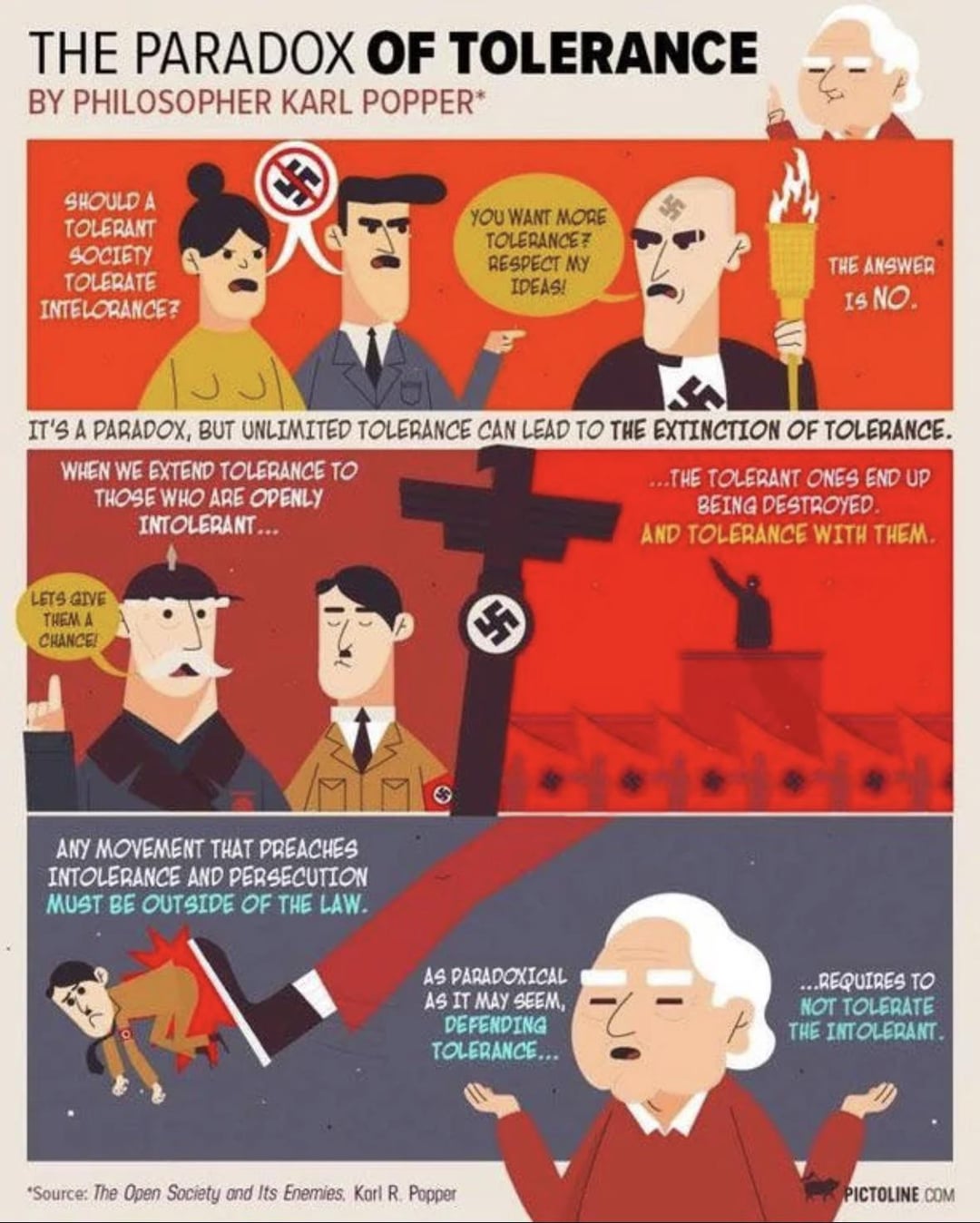
Any movement that preaches intolerance and persecution must be outside of the law.
This is a common misconception about the Paradox of Tolerance, and I’m going to reference the person who invented it: Karl Popper in his 1945 work, The Open Society and Its Enemies:
I do not imply, for instance, that we should always suppress the utterance of intolerant philosophies; as long as we can counter them by rational argument and keep them in check by public opinion, suppression would certainly be most unwise.
But we should claim the right to suppress them if necessary even by force; for it may easily turn out that they are not prepared to meet us on the level of rational argument, but begin by denouncing all argument they may forbid their followers to listen to rational argument, because it is deceptive, and teach them to answer arguments by the use of their fists or pistols.
Popper argues that we should tolerate intolerance only up to the point of violence. That is, if one physically attacks us, we no longer have the burden of tolerance. Popper is commonly misquoted and intentionally misused to justify violence against disagreement, and that is clearly not his position.
The graphic above states that we should not tolerate “movements” which preach “intolerance.” This is a subjective standard. I think Islam preaches intolerance. By this standard, I would be justified in banning all Muslims from immigrating to Denmark. This is why Popper used the much clearer standard of physical violence. Any modern society must tolerate disagreement - including “intolerant” disagreement. We resolve that intolerance at the ballot box. We cannot allow physical violence. No, someone saying mean words is not physical violence.
But in Denmark it is illegal to preach intolerance, like racism and nazism.
Yes, we don’t protect free speech in Denmark. However we do not ban people who subscribe to intolerant ideologies, like Islam.
But we should claim the right to suppress them if necessary even by force
He then goes on, in the paragraph you quoted, to make it clear that it’s refusing rational argument that’s a problem because it can lead to violence, not violence itself.
Further, if you finish the paragraph it becomes clear that the opening statement is anything but a misunderstanding:We should therefore claim, in the name of tolerance, the right not to tolerate the intolerant. We should claim that any movement preaching intolerance places itself outside the law and we should consider incitement to intolerance and persecution as criminal, in the same way as we should consider incitement to murder, or to kidnapping, or to the revival of the slave trade, as criminal.
You don’t have to agree with him, you can be partial to rawles, but popper was not vague.
He then goes on, in the paragraph you quoted, to make it clear that it’s refusing rational argument that’s a problem because it can lead to violence, not violence itself.
Not just that. He also very clearly requires there to be the incitement to physical violence:
and teach them to answer arguments by the use of their fists or pistols.
I agree with the end of the paragraph. His definition of intolerance includes the incitement to violence, and what he argues follows logically.
Read it again. He’s using incitement to violence as a consequence to to be avoided, not as a driving factor.
for it may easily turn out that they are not prepared to meet us on the level of rational argument, but begin by denouncing all argument; they may forbid their followers to listen to rational argument, because it is deceptive, and teach them to answer arguments by the use of their fists or pistols.
He goes on:
we should consider incitement to intolerance and persecution as criminal, in the same way as we should consider incitement to murder, or to kidnapping, or to the revival of the slave trade, as criminal.
He was writing at the end of WW2. He was saying it would have been fine to stop the Nazis at the start, before they were inciting violence because they couldn’t be reasoned with.
It’s clear you don’t agree with his position , and that’s okay. You can just disagree with him.Read it again. He’s using incitement to violence as a consequence to to be avoided, not as a driving factor.
He’s explaining the why. That statement is there for a reason, and your reading implies it’s superfluous.
He was writing at the end of WW2. He was saying it would have been fine to stop the Nazis at the start, before they were inciting violence because they couldn’t be reasoned with.
The National Socialist German Workers’ Party employed violence well before they achieved power. Popper’s warnings are obviously an allusion to the Brownshirts.
It’s clear you don’t agree with his position , and that’s okay. You can just disagree with him.
This is catty. Like a little girl. I’ve extended you courtesy and I would appreciate reciprocity.
Catty? “Like a little girl”? The hell is wrong with you people that you’re looking so hard for insult where none is intended? I apologize for being too casual in my assertion that I think you’re bending the work to fit your views instead of explaining why you think his views on tolerance aren’t correct.
Yes, I’m saying he included that statement because it’s the “why”. Suppression of intolerant speech can be justified because it can lead to violence. The violence or incitement thereto isn’t a precondition that justifies suppression in his view, but the end state to be avoided.
I’m not sure what you’re saying by drawing a distinction between the Nazis and the brown shirts or spelling out the party name. I know the Nazis were violent before they had political power.
That doesn’t really have anything to do with what I said.
I disagree with this assessment of the text - assuming it’s correct, I’m not familiar with the source.
What this extract is saying imo is as long as it’s possible to effectively keep in check and counter intolerance with argument and public opinion, suppression is unwise.
But, tolerance should reserve the right to suppress intolerance before it becomes violent, specifically when intolerance acts in bad faith and refuses to participate in logical argument or debate, and instead denounces argument entirely.
So the threshold is not violence itself, but one example of what “may” lead to violence.
Just my 2¢ on the text (not my opinion on the topic).
There is no way to reconcile your interpretation with the actual text:
and teach them to answer arguments by the use of their fists or pistols.
A preemptive strike is neither stated nor implied by Popper. I find that a dangerous proposition for a democratic nation. It would justify any and all manner of violence based on nothing and anything but the subjective and active imaginations of the politically inclined.
I’ve re-read it and still kindly and respectfully disagree about the meaning of that excerpt in isolation. Whatever the implications of this interpretation are, I have no idea because I’m not familiar with the work (however naïvely).
Here’s a detailed breakdown of my take:
I do not imply, for instance, that we should always suppress the utterance of intolerant philosophies;
The key word here is always, so, intolerant philosophies shouldn’t always be suppressed.
as long as we can counter them by rational argument and keep them in check by public opinion, suppression would certainly be most unwise.
The condition for not suppressing intolerant philosophies is if they can be kept in check and countered by public opinion and rational argument.
But we should claim the right to suppress them if necessary even by force;
Reserve the right to suppression if necessary…
for it may easily turn out that
Because the following things might easily happen:
they [the intolerant] are not prepared to meet us on the level of rational argument, but begin by denouncing all argument they may forbid their followers to listen to rational argument, because it is deceptive, and teach them to answer arguments by the use of their fists or pistols.
An example of what may occur when the first approach fails due to essentially bad faith, and the reasoning for why to reserve the right to suppression. But it doesn’t frame violence as the threshold for when to apply that suppression.
Anyway, that’s my take. I’m still assuming this quote is accurate - I haven’t checked it.
And once again I’m absolutely not agreeing with these positions or assertions about the suppression of intolerance, this is just how I understand the text.
and teach them to answer arguments by the use of their fists or pistols.
This is the operative statement to which I’m referring. If the party to which Popper is referring is not “answering arguments” with “fists and pistols,” Popper is not making an affirmative case for suppression.
To be clear, he’s not making an absolute statement either. He’s not saying, “we may only ever suppress speech which is violent.” However - and this is critical - he’s also not making an affirmative statement that speech without violence should be suppressed. This is the original work and quote used to derive the Paradox of Tolerance, so I think it behooves us to heed that in this statement, he’s referring to physical violence. Further, there are no statements of his in which he argues for suppression of non-violent speech.
Thanks for clarifying the quote’s source etc.
I still kindly disagree with this understanding of the language though.
To me that whole section is justification for why to reserve the right to suppression: because the intolerant may not engage with argument in good faith, and they may instead tell their followers to denounce logical argument altogether and be violent.
The key word here is may, which to me means “this might happen”. I basically read this as a warning of a potential outcome of intolerant philosophies - and why suppression might be needed and why to reserve the right to it - but not a threshold for when to suppress them.
But, at this point it seems like we might just have to agree to disagree on the meaning of the quote!
And once again, none of this is my opinion on the topic itself and I’m not endorsing a position, I’m only offering my understanding of the quote.
I will try to address your statements in turn as I don’t think I am doing a good job of articulating my thoughts. That said, I think we are closer than I originally believed.
To me that whole section is justification for why to reserve the right to suppression: because the intolerant may not engage with argument in good faith, and they may instead tell their followers to denounce logical argument altogether and be violent.
The section justifies when it may be reasonable to suppress incitement to violence. The “and” operator requires the incitement to violence in the premise: “But we should claim the right to suppress them if necessary even by force; for it may easily turn out that they are not prepared to meet us on the level of rational argument, but begin by denouncing all argument they may forbid their followers to listen to rational argument, because it is deceptive, and teach them to answer arguments by the use of their fists or pistols.”
Popper did not write “or.” Both incitement to violence and rejection of rational argument is the [non-exhaustive] example Popper uses to justify the right of suppression.
The key word here is may, which to me means “this might happen”. I basically read this as a warning of a potential outcome of intolerant philosophies - and why suppression might be needed and why to reserve the right to it - but not a threshold for when to suppress them.
I agree. As above, the example he used it not explicitly exhaustive. There may be other reasons to claim the right of suppression. However, Popper never used any other examples as valid cause to suppress speech, and in the immediately prior statement, cautioned that suppressing democratic speech is “most unwise.”
Given this, the implied claim that Popper and/or the Paradox of Tolerance supports the categorical suppression of “intolerant” speech (as the comic does) are inaccurate.
I guess my view on that section is still that it’s just an example of what can happen and why to reserve the right to suppression, but not a threshold or reasonable scenario for when to apply suppression.
for it may easily turn out that…
To me, this really isn’t saying: “this is one case where it’s reasonable to apply suppression”, but rather more simply: “because the following may easily occur with intolerant philosophies”.
Anyway, I appreciate you taking the time to reply and expand more on your take. I think let’s just say we understand it differently and leave it at that?
There’s a straightforward way to resolve the paradox of tolerance, IMO. Treat tolerance as a social contract. An intolerant person has explicitly rejected the contract.
Fully agree. Being tolerant is part of the social contract. If you break the rules then why should we play the same game.
I agree. Straightforward and simple. But I don’t think I know how to simply explain what a social contract is to someone. Does anyone have a good example of a social contract?
Choose to fit your audience:
-
Do unto others as you would have them do unto you
-
If you deny my right to exist, you forfeit yours
-
Fuck around and find out
-
Talk shit, get hit
You forgot one:
- Act only according to maxims which you would have be universal
In other words, don’t do something that you would be upset if someone else did.
This. I’m not sure why others are arguing your point. I guess they don’t actually understand what you’re saying?
Happens all the time to be honest
This doesn’t work in everybody. There’s a lot of things I like, and I would want everybody to do, that I recognize most rational people would never want.
If I followed this advice I would bother almost everybody I interact with.
The majority set the vibe. It’s ugly, but there it is. If I reject this it will only cause friction in my life. So for people like me, a better quote is:
Act only according to maxims which those affected would have be universal
Perhaps. But the same would apply to the other golden rule. It’s not “Do unto others as they would have you do unto them.”
If you do what you feel is right, it doesn’t matter if people disagree with you. You’d at least be ideologically consistent, not a hypocrite.
If being a good person requires pleasing people, there would be no good people in the world. “People” are impossible to please because it’s an abstract category representing a generalized collective. You’ll never please them all and that’s okay.
Do what you believe is right, and sleep well at night knowing you tried your best.
If I remember correctly, Kant goes into detail about how others would be affected and how that influences the categorical imperative. I forget exactly what he says about it though
If your definition is “do what you believe is right” it absolutely needs to be paired with a requirement to put effort into figuring out what actually is right.
Well when you figure that part out let me know, I’ve been trying my whole life and so far everything I’ve come up with is bound to still piss someone off…
If your definition of right and wrong is based on what gains approval from others then you’re in a very dangerous predicament and I hope to the gods I don’t believe in that you’re surrounded by decent people.
-
An agreement made to be able to share each other’s space
Mutual assurances of safety in exchange for mutual acceptance of limits in regards to your shared spaces
If you break one of these agreements to others then you lose the privileges that they offered you
By demanding the benefits of a society you commit to honoring what it requires of you to maintain it
Look at stuff like the rules applied by hikers in the wilderness. “leave no trace” and sharing resources. Then you filter out a ton of the complexities of cities to show the basics of what it is.
This is an asked and answered question.
Tolerance is not a moral stance, it is part of the social contract. Those that violate the social contract, like Nazis, are not protected by it. Paradox solved.
Exactly. The “paradox” part disappears as soon as you start viewing things through the lens of a social contract. The intolerant are intentionally and repeatedly breaking the social contract, and are therefore not protected by it.
Understand tolerance as a social contract and not as a moral obligation. Tolerance is about piece within a society, not about right or wrong. If you do, there is no paradox, because the contract is broken and therefore does no longer apply. It also allows you to counter far right ideologies from whomever they come.
“Tolerance has a limit. Beyond that limit, intolerance becomes duty.”
- Rig Védā
It’s not a paradox, it’s a social contract.
I am tolerant of everyone except those who are intolerant of people doing things that hurt no one and/or those who hurt others.
You don’t like Nazis? Tolerance granted.
You don’t like trans people? Tolerance denied.
It’s incredibly simple to understand, isn’t paradoxical and is easy to live by.
So if someone says something racist or transphobic, I can kill them, right?
Or perhaps what constitutes a violation of the social contract and what constitutes an appropriate penalty is actually not simple.
To provide a concrete example; the Catholic church, as an organisation, doesn’t like trans people. What would tolerance being denied to the Catholic church look like in your world?
Something something due process, proportionality principle, etc. This isn’t exactly trivial, but that first rule does help in determining who is the one infringing. To start with, both starting shit as well as unjustified escalation are both punishable.
It doesn’t really help in determining who is doing the infringing either. There are places where saying “from the river to the sea” would be considered to be infringing on the social contract. And given that the social contract is a social construct, who’s to say they’re wrong?
Again, who is harmed?
And when one side is clearly hypocritical, we can establish that that their contract is unbalanced and unfair and strike the unfair terms.
… like for example determining that people like Netanyahu don’t have the moral authority to punish others from doing what he himself does;
https://newrepublic.com/post/178243/benjamin-netanyahu-literally-says-from-the-river-to-the-sea
We already have whole fields studying precisely this line sociology and more, analysis of power balances and stereotypes, and more. Again, it’s complicated, but it’s not happening in a vacuum, we know how to approach this
yes, and the legal framework can (and should) differ from the social contract
This is why they are trying to make “establishment” a slur
It’s closer to the social contract of tolerance. If the contract is broken then the gloves are off, no one gives a damn about the universalist Christians but the Evangelicals are broadly hated on average, hell even my bloodthist is generally more socially acceptable than your average Evangelical since my focus is moreso directly on folks and entities who cause harm through secondary or primary effect.
Why are we so tied to the word tolerance specifically? Decency, kindness, courtesy, and empathy seem to be more what were all aiming for anyway.
Is it cuz tolerance is the bare minimum? (This is a genuine question)
Tolerance is useful because it conveys the notion of restraining from persecuting someone for something you specifically and perhapse strongly dislike (as long as it doesnt cross certain lines). It makes it unacceptable to use state or social power without a reasoned argument for actual harm.
So much of this shit is stacked on top of established cultural and social mores anyway.
Case in point, “Decency” can mean a lot of different things to different people. Is this about self-policing your speech and dress? Or extending charity to your neighbors? Or simply staying silent so as not to appear rude? Or being an outspoken crusader in the face of rudeness and impropriety?
Is it cuz tolerance is the bare minimum?
Tolerance is the benchmark for an egalitarian society. And the Hitler/Nazi reference is intended to illustrate the perils of showing tolerance for a foreign belief system, which queues up the “paradox” in question. If your goal is egalitarianism, how do you police against anti-egalitarian sentiment dressed up as “just another point of view”?
And who gets to decide what gets tolerated, anyway? Because any road you take can get you back to fascist tendency.
Is “intolerance of the intolerant” an excuse to wipe up a mob against a foreign religion you find distasteful? Is it a reason to break up social events or try and heckle opposition politicians or vandalize property? Or is it just a vibe you express when prompted, while otherwise allowing the “intolerable” ideology to persist?
This line of logic also doesn’t really answer the hard questions, like, “What if the cops are in the club that you find intolerant?” Or “What if the national media club is promoting intolerant beliefs?” How do you refuse to tolerate the powerful, the wealthy, and the socially insulated?
To be fair I get the idea of the comic.
It’s more about how the word tolerance is a bad descriptor of what we’re after, and honestly, the Right can tell. They know we CANT tolerate them, and jumping through hoops to justify the use of the WORD tolerance is absurd to me.
Obviously this isn’t very important in the grand scheme, it just kinda annoys me
Tolerance is such a low barrier to pass - being as basic as “do nothing” - that is boundary acceptable even for the Right, because to it does not obligate anybody to act (in favor of others) and thus fits even those with a “what’s in it for me” who will indeed do nothing if there’s nothing in it for them whilst still being within the tolerant side of it.
I assume your referring to the Liberal Right and not the Conservative Right
I would guess that is why. We should push for greater ideals, as you say, but I will begrudgingly accept tolerance as the minimum.
One of these people replying here supports a regime that forcibly “reeducates” minorities and ban teaching of their languages, tolerating only a uniform national identity.
The irony, right?
It’s funny how the word “tolerance” already implies that something is bad but you just act as if it’s not. You wouldn’t tolerate having enough food and water, you’d only tolerate the lack thereof.
Because its a bad faith argument.
Not “bad”, just “not your preference.” I tolerate reality TV like 90-Day Fiance but it’s not objectively bad. And, subjectively, it’s better than most reality TV I’ve seen.
I tolerate eating Shin ramyun noodles when I’d rather be eating pad thai.
Similarly, you can tolerate people’s life choices (e.g. “polyamory, as a relationship choice, or smoking weed”, not “being gay or being trans” which is someone’s intrinsic self) even if they’re not your preference. And that doesn’t imply anything about the choice.
And, as an aside, I think political polarization has erased the place of “tolerance” in discourse. Because now, tolerance looks like acceptance when a bigot wants to murder someone for choosing different. You have to vocally, enthusiastically be an ally to counteract the polarized hatred from the other side, and maintain some semblance of the world making sense.
deleted by creator
It implies something has to be tolerated because it is outside of the realm of the familiarity you would otherwise personally accept innately. Not bad, just an admission of the fallibility of personal experience at being completely objective at everything.
Intolerance to not tolerant - just use the double negation and the paradox disappears.
It never really seemed like a paradox to me to begin with. To suggest that it is is just a rhetorical game used by the intolerant in bad faith.
The person who put forward the idea, or gave it a name, was a pretty notable philosopher who was notably in favor of a discourse driven liberal democracy, and against fascism.
He didn’t mean paradox in the sense of “self contradictory and unresolvable” like the liars paradox. He meant it in the sense of “seemingly contradictory”.
In order to have the most tolerant, rational discourse driven society possible there are some things you cannot tolerate, nor engage in discussion with , because if you cannot be persuaded there cannot be rational discussion.
So the paradox was named by a person explaining why you don’t have to listen to Nazis just because you want to be open to new ideas and perspectives.
Coming to the conclusion that it’s not contradictory is agreeing with the argument that it’s okay to just tell Nazis to fuck off.
I see, well said. I’m not well informed on the absolute origin of the phrase. It wasn’t clear to me if the philosopher was responding to people saying that being intolerant of Nazis/other types of bigots in the pursuit of tolerance of diverse types of people was contradictory and therefore not morally or ethically sound, or just spontaneous hand-wringing.
Not a direct response, but a response as part of a larger philosophical narrative.
He was a true believer in a society driven by rational discussion and the free exchange of ideas, which was the main point of his work.
As part of describing how he thought society should be run (tldr: we should discuss things, change institutions peacefully, and make small changes that we can actually tell if they worked instead of upending society in the name of an untested ideology) he spent some time describing the edge cases and weaknesses, which is where the quote comes from.He wrote the work during WW2 after fleeing Germany, so there’s more than a little implied context that people would have at the time of publication. Basically a general vibe of “what the fuck! Let’s not do that again!”
I’ve posted about this exact fucking thing before and I completely agree. There is no paradox, it’s just a bullshit argument easily dismantled
Well, it kinda is, if you take the terms at face value: To defend tolerance by being intolerant.
The fact that it can be simply resolved by requiring tolerance to be mutual doesn’t make the original less of a paradox.
I see what you’re saying, but to me it’s not a paradox that needs addressing because to most people it’s obvious that these are qualitatively different kinds of tolerance. To me it feels like a technical gotcha divorced from the obvious intent. I might be assuming too much there.
I think tolerance is simply a liberal idea, and it’s been a demonstrably exploitable one. The moment a reactionary says “aren’t you supposed to be tolerant”, I simply don’t know where they’re getting that from. I tolerate what I want, and the intolerant don’t get to invoke my tolerance.
Worth noting that “the tolerant left” was a term coined by conservatives, specifically to try to guilt the left into accepting them (and giving them ammo to use when the left rejects them).
I thought it was an ironic insult used to fool their base that the other side was irrational.
Tolerance is, by its very nature, limited. That’s the whole point.
It isn’t some sort of ideal, like empathy, where more is better (although there are people, mostly bigots, who want to convince us otherwise), instead it is the result of our moral and ethical positions.
We tolerate what we think is ok, we don’t tolerate what we think isn’t ok.
Who’s in charge of what is and is not “intolerant”?
that’s the problem
For example, Christianity, Islam, Judaism are ALL intolerant faiths by their own admission.
Shhh Redditors really like this idea.
i’d say it’s relative to your culture. if you’re a liberal woman growing up in iran or saudi arabia you’re gonna hate your life.
but this opens up genuine discussions about right/wrong and whatever else.
the fact of the matter is that we just make up everything about humans and their relations as we go along. there is no real right or wrong, there’s just perspective in any given moment in time and context.
if there are 34738434739473 iranian women who support their lifestyle and 40000 who don’t then who’s right?
according to americans the minority is right, but we pretend that they aren’t in america when it comes to domestic concerns.
whoa.
For example, Christianity, Islam, Judaism are ALL intolerant faiths by their own admission.
I know of a guy with a funny mustache who solves this problem by being intolerant of the… Hey wait a minute…
They’ve been murdering each other over their religious disagreements for more than a thousand years, long before he ever came along. He just used them, like a tool, to reach his own ends.
He gave those who believe in such tripe the opportunity to exercise their beliefs “legally”. They are waiting for another opportunity to do their holy work, always. Something something “chosen people”, there can be only one.
The whole confusion comes from upholding tolerance as a principle or ideal rather than actually understanding it’s purpose. When people look at it that way, they either accept it or reject it, but both of those are wrong.
Where does the idea of tolerance come from? Hundreds of years ago, the West was wracked with constant wars of religion between Catholics and Protestants, on top of witch hunts, crusades, inquisitions, the whole “scarlet letter” thing. It was after this whole mess that people decided that it wasn’t worth it anymore, and that we should just call truces, that we should allow each other to practice different faiths without coercion. Eventually, this expanded to other aspects beyond just religious beliefs, however, the fundamental core of what it is is that truce between religious factions.
In many cases, it is possible to discuss disagreements and resolve things, or, it is possible to coexist while believing different things. Whether the sacremental wine turns into the blood of Christ literally or figuratively is a perfect example of that.
However, it should be noted that this was a practical compromise driven by a balance of power between the respective sides. The word, “tolerance” should not be confused with the word, “acceptance.” To tolerate something implies that you wish it were different, and you’re just putting up with it out of necessity. It is a truce, a contract, a ceasefire, between different parties with conflicting aims and ideals. Go back in time and give either side modern assault rifles, a clear advantage, and they’d drop the idea of tolerance in a heartbeat.
When a ceasefire is violated, a certain degree of patience is called for. Itchy trigger fingers can destroy a peace that both sides are invested in maintaining. However, if one side is able to repeatedly and brazenly violate the ceasefire without consequence, then the ceasefire is essentially dead and no longer serves a meaningful purpose.
To view tolerance as a principle and ideal in itself means that you’ve already decided whether you’re going to uphold or abandon the ceasefire before you’ve even seen how the other side is acting. Accepting tolerance on principle means letting people take advantage of you, while rejecting it on principle means alienating potential allies.
Obviously, it’s impossible to tolerate the right because they are so intent on aggression against vulnerable people. However, and this is true, it is possible to tolerate different perspectives on the left, while disagreeing with them. Rather than letting one’s experiences with the right inform their approach to tolerance in general, we should look at what is actually minimally necessary to coexist and potentially collaborate with people we disagree with. Instead of logicking one’s way into saying that anyone who disagrees on any point is technically being intolerant and therefore paradox of intolerance, deplatform them and treat them exactly like fascists, consider whether they are actually being bigoted and intransigent, or whether it’s more mundane disagreement.
I have conflicting thoughts about this.
More often than not this explanation is just used as a excuse to hate whatever group you want while labeling yourself as the good one. But applied to the ultimate consequences most people would still be intolerant.
The classical example of not tolerating nazis because they are intolerant to others, is used because it’s a flawless example. The definition of a nazi is a person who wants to eliminate other groups from society just because what they are. A tolerant society cannot exist with them, so they have to go. Perfect.
But we have real life problems when we move from the perfect example to practical cases.
1The “everyone I don’t like is a nazi” problem. Someone who wants to be a good intolerant just have to label their opponents as nazis, no matter if they are or not. Just the label is good enough.
While Nazis are used as a classical example. The more pure definition is, that tolerant society should not tolerate people who are intolerant. Thus, only allowed intolerance is the intolerance to the intolerant, any other type of intolerance should then make you a valid target for intolerance.
And here is when I see the biggest problem. That society doesn’t usually fit most people values. I would give you several examples. Take billionaires, take robbers, take whatever kind of person you don’t like, not only don’t like but you don’t want anyone like that in your society, for reasons different to them being intolerant. There are other undesirable values in a person that sometimes are worse than intolerance. The lack of tolerance to those people really puts you in the same spot as the Nazi in the paradox of intolerance. As you are hating on people for reasons different than they not being tolerant.
I see two honest solutions and one dishonest one.
The first honest solution is to strictly adhere to the idea of being tolerant everyone but the intolerant idea. Which will imply a higher effort to accept people in the society that you currently don’t want to accept. Embrace that tolerance is the ultimate goal and just reject the intolerant, accepting everyone else, no matter what.
The second honest solution is to reject complete unconditional tolerance to everyone but the intolerant. Create a more strict set of values of what the society should tolerate. And embrace the idea that complete unconditional tolerance is a not the goal.
The dishonest solution is just lie about it. Seek excuses, loopholes or overcomplicated cherry picking reasonings on why the people you don’t want to tolerate are actually intolerants and then covered by the paradox of intolerance and be happy with it.
To each their own. In the later years I’m feeling myself leaning more for the second honest solution. Unconditional tolerance is not a goal per se. I try to create a developed moral system that could actually be universal and that everyone and anyone could and should follow. And think that maybe I should not tolerate anyone that breaks this ethical rules. Basically instead of saying that the “golden rule” is to be tolerant and that’s the only rule that people is not allowed to break. My golden rule is more on the lines of “be a good person”, which is harder to define but I think it’s more solid, and that’s the only rule that should not be broken.
And here ends my TED talk.
Nobody says “everyone I don’t like is a Nazi”. But a lot of Nazis, who are rightly disliked by most people for being Nazis seem the see things that way.
Never heard “they call anyone with a different opinion a Nazi!” where the opinion in question didn’t turn out to be some real Nazi shit.
everyone says that the people thry don’t like are nazis
Example: "Unless you’re a republican or other type of nazi. Then you can absolutely go all the way to hell.
Tolerance got us here."
this person, comment copy on lemmy, is actually implying that every republican is a nazi. Their use of the world “tolerance” makes me think that they are actually an example of what I say that people use the paradox of intolerance as an excuse to feel vindicated about their thoughts rather than as a moral theory to follow. It’s the first example I found, but I think is hard to deny that a non negligible number of people think that one of the two major parties in the US country is a nazi party. Giving that the US is a two party system saying that the only other side are all nazis, is almost equivalent to saying that everyone that doesn’t think like me are nazis.
I’ve also seen a lot of the time the argument “if you have a table of 10 people sitting with 1 nazi, you have 10 nazis”. It’s a common argument, that’s not even related to those other 9 people ideologies, just that they shared a space with a nazi they automatically get counted as nazis.
As an exercise to these people I would like to ask what “constitutes a nazi” by their thoughts. And afterwards calculate what many people in their country falls under that definition. If the number is high enough I think is more likely that the person is calling nazi to every person who doesn’t think like them rather than such a big chunk of the population actually beliefs and follows the national-socialism ideology of Adolf Hitler.
republican or other type of nazi
The Republican party is currently openly supporting the idea of masked secret police disappearing people off the streets and sending them to concentration camps based on their race.
Yes, Republicans are Nazis. Yes, that includes the ones you’re friendly with.
I have beef with both parties, so if that’s what I were doing, I’d be saying it about a lot more than the third of the country that’s openly decided to support Nazism. As far as everyone else, your argument still fails to persuade, because the statement “Republicans are a subtype of Nazi” is factually correct by any reasonable analysis. So no, even at that scale it isn’t “everyone who doesn’t think like me” it’s “everyone supporting this plainly Nazi shit we’re seeing daily in real time”.
I’ve also seen a lot of the time the argument “if you have a table of 10 people sitting with 1 nazi, you have 10 nazis”
That’s the crux of the paradox of tolerance. People who are tolerant of Nazis have the same net effect on society as Nazis themselves. Making no distinction between someone who openly supports throwing people into camps based only on their race and people who don’t actually support it but are fine enough with it to have a friendly dinner with someone who does is again, the objectively correct position.
It sounds to me like you’re either the Republican variety of Nazi or the “apolitical go-along-with-it” style of Nazi and you’re looking for validation that you aren’t a Nazi. You won’t find that here. It’s not because I disagree with you, it’s because you’re openly arguing for tolerance of Nazis.
The Republican party is currently openly supporting the idea of masked secret police disappearing people off the streets and sending them to concentration camps based on their race.
Using your example, that means the Democrats are also Nazis; they’ve also used ICE (with masks) to deport millions of people at gunpoint for concentration camps and/or deportment.
Exact same organization. Same masks. Same camps. Millions of times.
So… if you’re a Democrat, per your own example you are a variety of Nazi… in which case I agree with you.
Using your example, that means the Democrats are also Nazis; they’ve also used ICE (with masks) to deport millions of people at gunpoint for concentration camps and/or deportment.
No argument here, but that wasn’t the point under discussion.
You are kind of proving my point by wildly missing my point.
First here we are with the “you are a nazi” argument. You disagree with me, I’m automatically a nazi.
Second of all. If you read my comment again you’ll clearly read that I advocate that tolerance is not the goal. I’m not saying we should “tolerate” nazis. I’m actually advocating for not tolerating not only nazis but a whole bunch of other people as well (I just don’t feel the need to call them nazis for not tolerating them), because I think tolerance by itself is not the supreme golden rule that will make the society we live into the utopia we deserve.
But the point is that once you are true about this you should construct a more robust moral code that “nazis bad and everyone I don’t like is a nazi”, because that’s just not going to get us anywhere. We need good people in our society. Not just thugs flying your favourite flag. And for that the definition of who stays and who don’t shouldn’t be a political tag. But the adherence to a robust moral code.
But obviously bad people who think they are good only because their political tag doesn’t find this a very pleasant idea.
You disagree with me, I’m automatically a nazi.
No, I disagree with almost everyone.
You argue that people supporting masked secret police disappearing people based on race doesn’t necessarily make them a Nazi, and that argument makes you a Nazi. It really is that simple.
You want to define “Nazi” as meaning only people following the exact political philosophy of the 1930s NSDAP, which is exactly how neonazis and other Nazi subtypes want it defined, as it keeps them from being banned for being Nazis.
“Nazi” to most people means anyone supporting a militarized ethnonationalism, and especially anyone supporting the use of state violence against designated out groups. For the most part that means Republicans and their supporters, along with Zionists and their supporters, plus assorted independent neonazi factions that don’t have those kinds of numbers. But yes, it also includes anyone looking at what those groups are doing and arguing they aren’t Nazis, or ignoring that they’re Nazis for social or business reasons.
My definition of Nazi in the modern sense of the world, (a neonazi we could say). Is that of a person who wants the state to have absolute power to enforce a reactionary society that will embrace a glorious past, exterminating every group of population that doesn’t fit into this objective.
By that definition, no not all republicans are nazis, some are, of course, many even, but not all, not by far. And obviously, not all people who deny your arguments about who is a nazi automatically becomes a nazi.
It doesn’t mean they are good people. But here is the thing, not every bad person is a nazi.
You might be a very bad person, and still not a nazi.
A problem with you way of seeing things, is that, is conveniently arbitrary. You can actually call absolutely anyone you like a nazi. That’s a fast route for authoritarianism. Tou want to kill anyone? Easy, you say they are a nazi and their death is justified in your eyes.
That’s just bad. You can have a system that defines who is good and who is not by such an arbitrary system.
Look at it this way. By your definition you are yourself a nazi. Because if I’m a nazi and I’m here you are sharing this space with a nazi, making yourself a nazi… See how easy is to label someone as a nazi by those definitions?
No. Our moral system should be stronger, should be able to accurately determine if a person is a good person or not based on their actions, without any chance of arbitrary labeling any person as bad by the convenience of an authoritarian figure.
Your inability (or more likely refusal) to understand simple concepts doesn’t invalidate those concepts.
There is nothing arbitrary about “people who support a militarized ethnostate” nor about “people who support state violence against a designated out group”.
No part of the "ten Nazis at the table is about sharing space, it’s about it ignoring their atrocities and being friendly with monsters.
If you want people not to say you’re a Nazi, why don’t you try just saying without any prevarication “masked secret police snatching people off the street because of their race is wrong, that’s Nazi behavior and people who support it shouldn’t be tolerated”.
You won’t. Because you clearly do support that kind of behavior.
implying that every republican is a nazi
You seem to be implying that not all Republicans are not Nazis.
10 years ago it was true that not all Republicans are Nazis. However, there has not been no resistance from every elected Republican to the Nazi movement within the party for far too long to be able to honestly make the claim that Republicanism is not Nazism.
I’ve always wonder. Why some people is so eager to make everyone their worst enemy.
I remember this joke, about the difference between a republican and a democrat:
There comes a new guy to the republican party and they ask them:
- Are tou against abortion?
- Yes I am.
- Good, are you pro christian?
- Yes I am.
- Good, do you hate the gays?
- No, I don’t hate them.
- Don’t worry, you’ll get there, grab a beer mate!
Meanwhile other guy enters the Democratic party and they ask them:
- Are you agaist the Climate change?
- Yes
- Good, are you pro LGBT?
- Yes I am.
- Good. Are you in for taxing the rich?
- I’m not sure, maybe I don’t believe in that.
- Get out of here you Nazi scum!
My point is that even as a political strategy we might be better off trying to find reasons on why other people is “one of us” instead of trying to find reasons on why they are the worst scum on earth.
My point is that even as a political strategy we might be better off trying to find reasons on why other people is “one of us” instead of trying to find reasons on why they are the worst scum on earth.
This is an extremely valid point you are making. It is why I oppose Democratic leaders like Gavin Newsom, Amy Acton, etc throwing trans people under the bus in an effort to get Republican voters.
The rest of your comment is incredibly anectdotal, and doesn’t match with my lived reality, where local Republican leaders called me a pedophile because I hosted some drag shows. My experience has been that Republicans lead and convince with fear, as opposed to using intellectualism to get people to hate gay people. Sure, that convincing may be incremental, but I don’t think the conversation you created in your head has ever happened in any reality.
Likewise, I have never seen a Democrat organization kick someone out for being opposed to taxing the rich, let alone call them a Nazi. In fact, most of the Democratic party’s leadership at the national and at state levels oppose taxing the rich. That’s why the DSA and similar parties/caucuses are gaining power within the Democratic party.
But let’s be clear, the story you made up in your head, has never happened, despite how fucking erect I would get if it did happen. Your story is less believable than Candyland.
All Republicans are Nazis. Republicans may be misguided in why they are voting Republican, but that doesn’t make them any less of a Nazi.
A Republican voter may be incredibly passionate about crashing the economy (9 of the past 10 economic recessions have been caused by Republicans), and they may be voting Republican because they want to crash the economy. But they doesn’t absolve them of voting for ICE to terrorize communities.
We didn’t give the 1940s Nazis a pass because they didn’t know what that the wretched smell was bodies burning. We treated them exactly as who they were: Nazi scum.
Just as a note. The Allied powers gave most nazis a pass. Only 24 people were judged in the trials of Nuremberg. Most people who voted for Hitler’s, even members of the Nazi party were not judged by it once they surrendered.
It was understood that most of them were probably not inherently evil, even when they were on the (very) wrong.
I would assume most republican voters would be the same. Most I know are on the wrong, but they are not inherently evil. They’ve been lied and manipulated, but deep inside they would probably just want to live happy peaceful lives like all of us.
Most people look back on Nazi Germany and see the populace as the Nazi scum they were. Most of the populace that wasn’t a victim, including the ones that voted against Nazism, deserve this treatment, as they did not do enough to stop it.
Being a billionaire is a choice, a choice to hoard money to the detriment of everyone and everything around you. One could easily choose to not be a billionaire by paying taxes and funding their local social support services and donating to charity. Intolerance of greed on the scale of billions of dollars should be the norm as it is actively detrimental to society.
Robbery is a violation of personal safety and social boundaries and is also actively detrimental to society. It is also a choice.
Intolerance of the choices of others that violate the social contract of “don’t be greedy, don’t steal, don’t hurt others, etc…” is valid intolerance in my opinion.
Nazis are intolerable because they are intolerant of the vast majority of humanity itself and for reasons outside of most people’s control. Sure, you can make it a choice and convert to Judaism, but the vast majority of Jews are born into Judaism; It’s not a choice like greed on the scale of billions or breaking and entering.
For that reason alone, Nazis are worth disposing of. The myriad additional reasons to hate Nazis just makes the job easier.
There are also a plurality of underlying issues not explored by this, because it’s treated as first order only problem. Like… why is it that people become intolerant and why they blame certain groups for things.
And usually that’s underlying economic or inequality conditions in the society or other forms of social upheaval… which people generally don’t want to address so much as they want to focus on the social sorting of hating and being hateful as the ‘solution’. It’s much easier to be tolerant when you are in an environment where members are all roughly of equal status, harder when there are perceived or real inequalities and abuses of power.
Real world is more complicated because people don’t hate for no reason. They may, have very legit reasons, and you likely may have the same reasons directed towards a different group.
Everyone does vastly over simplify this, because well, they want to use is as a litmus test to prove they are good and other people are bad, and that’s the only ‘use’ of this principle. Which is what folks do with a lot of moral/social guidelines… they want to reduce them to sorting mechanisms with themselves on the ‘right’ side of the sort… and if you challenge that notion maybe it’s not that simple… you must be one of the ‘bad’ people.
Further, everyone is intolerant of something. Even if they won’t admit it. Nor will they admit… that they and everyone else make mistakes. People’s mind and behaviors change… a whole other second order factor also totally outside the scope of this ‘paradox’. and for a lot of folks on lemmy… you can’t ever change or be reformed from your previous views… etc.
We also have the wonderful case of social movements that seek to turn innocuous behaviors into intolerable assaults on themselves, like the ‘manspreading’ nonsense from Tumblr.
I think it’s better understood as a phenomena, not a principle or a rule or any of that. You don’t have to ‘accept’ or ‘reject’ it. You should think about it though, about the implications of where you draw the line, because in real life it is never as clean as ‘nazis bad, everyone non-nazi good’, and there are so many legal and other examples that get into murkey waters.
But that’s just people exploiting ambiguity, not a real problem with the principle. It’s an implementation problem. And since every other alternative will be dependent on a similar definition with a threshold up define bad, this one can’t be substantially worse.
You’re counting wrong when you’re talking about “most”. If most people hated society you would not see cities larger than a few thousand people. People are annoyed by it, but they accept it because they know what they get in return (conservative propaganda is essentially about lying about what makes society good)
We already do partial tolerance. It’s called fines instead of deportation, it’s called reputation instead of tarring. What you’re really looking for here is stronger cultural enforcement.