The person who put forward the idea, or gave it a name, was a pretty notable philosopher who was notably in favor of a discourse driven liberal democracy, and against fascism.
He didn’t mean paradox in the sense of “self contradictory and unresolvable” like the liars paradox. He meant it in the sense of “seemingly contradictory”.
In order to have the most tolerant, rational discourse driven society possible there are some things you cannot tolerate, nor engage in discussion with , because if you cannot be persuaded there cannot be rational discussion.
So the paradox was named by a person explaining why you don’t have to listen to Nazis just because you want to be open to new ideas and perspectives.
Coming to the conclusion that it’s not contradictory is agreeing with the argument that it’s okay to just tell Nazis to fuck off.
I see, well said. I’m not well informed on the absolute origin of the phrase. It wasn’t clear to me if the philosopher was responding to people saying that being intolerant of Nazis/other types of bigots in the pursuit of tolerance of diverse types of people was contradictory and therefore not morally or ethically sound, or just spontaneous hand-wringing.
Not a direct response, but a response as part of a larger philosophical narrative.
He was a true believer in a society driven by rational discussion and the free exchange of ideas, which was the main point of his work.
As part of describing how he thought society should be run (tldr: we should discuss things, change institutions peacefully, and make small changes that we can actually tell if they worked instead of upending society in the name of an untested ideology) he spent some time describing the edge cases and weaknesses, which is where the quote comes from.
He wrote the work during WW2 after fleeing Germany, so there’s more than a little implied context that people would have at the time of publication. Basically a general vibe of “what the fuck! Let’s not do that again!”
I see what you’re saying, but to me it’s not a paradox that needs addressing because to most people it’s obvious that these are qualitatively different kinds of tolerance. To me it feels like a technical gotcha divorced from the obvious intent. I might be assuming too much there.


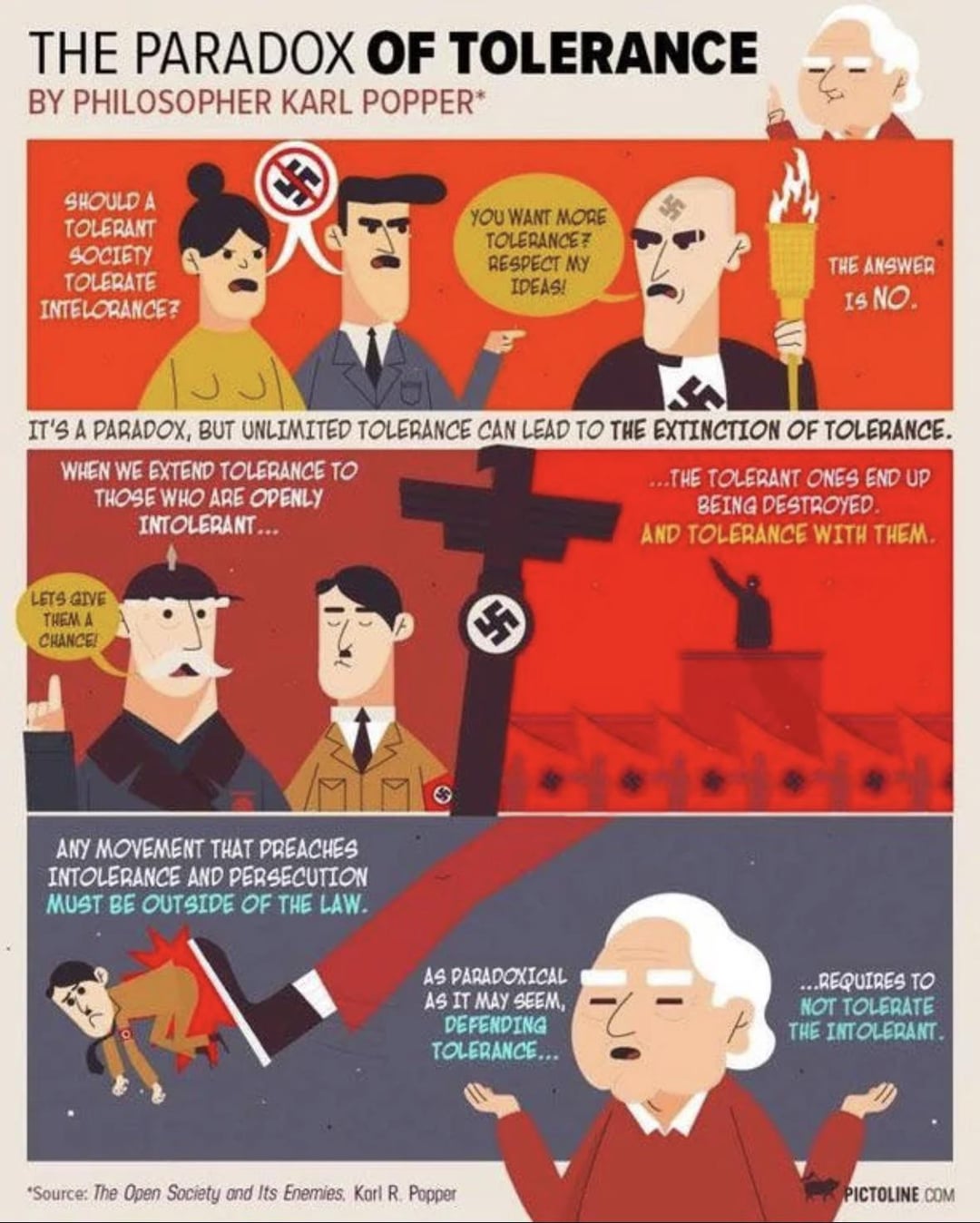
Intolerance to not tolerant - just use the double negation and the paradox disappears.
It never really seemed like a paradox to me to begin with. To suggest that it is is just a rhetorical game used by the intolerant in bad faith.
The person who put forward the idea, or gave it a name, was a pretty notable philosopher who was notably in favor of a discourse driven liberal democracy, and against fascism.
He didn’t mean paradox in the sense of “self contradictory and unresolvable” like the liars paradox. He meant it in the sense of “seemingly contradictory”.
In order to have the most tolerant, rational discourse driven society possible there are some things you cannot tolerate, nor engage in discussion with , because if you cannot be persuaded there cannot be rational discussion.
So the paradox was named by a person explaining why you don’t have to listen to Nazis just because you want to be open to new ideas and perspectives.
Coming to the conclusion that it’s not contradictory is agreeing with the argument that it’s okay to just tell Nazis to fuck off.
I see, well said. I’m not well informed on the absolute origin of the phrase. It wasn’t clear to me if the philosopher was responding to people saying that being intolerant of Nazis/other types of bigots in the pursuit of tolerance of diverse types of people was contradictory and therefore not morally or ethically sound, or just spontaneous hand-wringing.
Not a direct response, but a response as part of a larger philosophical narrative.
He was a true believer in a society driven by rational discussion and the free exchange of ideas, which was the main point of his work.
As part of describing how he thought society should be run (tldr: we should discuss things, change institutions peacefully, and make small changes that we can actually tell if they worked instead of upending society in the name of an untested ideology) he spent some time describing the edge cases and weaknesses, which is where the quote comes from.
He wrote the work during WW2 after fleeing Germany, so there’s more than a little implied context that people would have at the time of publication. Basically a general vibe of “what the fuck! Let’s not do that again!”
I’ve posted about this exact fucking thing before and I completely agree. There is no paradox, it’s just a bullshit argument easily dismantled
Well, it kinda is, if you take the terms at face value: To defend tolerance by being intolerant.
The fact that it can be simply resolved by requiring tolerance to be mutual doesn’t make the original less of a paradox.
I see what you’re saying, but to me it’s not a paradox that needs addressing because to most people it’s obvious that these are qualitatively different kinds of tolerance. To me it feels like a technical gotcha divorced from the obvious intent. I might be assuming too much there.