The whole confusion comes from upholding tolerance as a principle or ideal rather than actually understanding it’s purpose. When people look at it that way, they either accept it or reject it, but both of those are wrong.
Where does the idea of tolerance come from? Hundreds of years ago, the West was wracked with constant wars of religion between Catholics and Protestants, on top of witch hunts, crusades, inquisitions, the whole “scarlet letter” thing. It was after this whole mess that people decided that it wasn’t worth it anymore, and that we should just call truces, that we should allow each other to practice different faiths without coercion. Eventually, this expanded to other aspects beyond just religious beliefs, however, the fundamental core of what it is is that truce between religious factions.
In many cases, it is possible to discuss disagreements and resolve things, or, it is possible to coexist while believing different things. Whether the sacremental wine turns into the blood of Christ literally or figuratively is a perfect example of that.
However, it should be noted that this was a practical compromise driven by a balance of power between the respective sides. The word, “tolerance” should not be confused with the word, “acceptance.” To tolerate something implies that you wish it were different, and you’re just putting up with it out of necessity. It is a truce, a contract, a ceasefire, between different parties with conflicting aims and ideals. Go back in time and give either side modern assault rifles, a clear advantage, and they’d drop the idea of tolerance in a heartbeat.
When a ceasefire is violated, a certain degree of patience is called for. Itchy trigger fingers can destroy a peace that both sides are invested in maintaining. However, if one side is able to repeatedly and brazenly violate the ceasefire without consequence, then the ceasefire is essentially dead and no longer serves a meaningful purpose.
To view tolerance as a principle and ideal in itself means that you’ve already decided whether you’re going to uphold or abandon the ceasefire before you’ve even seen how the other side is acting. Accepting tolerance on principle means letting people take advantage of you, while rejecting it on principle means alienating potential allies.
Obviously, it’s impossible to tolerate the right because they are so intent on aggression against vulnerable people. However, and this is true, it is possible to tolerate different perspectives on the left, while disagreeing with them. Rather than letting one’s experiences with the right inform their approach to tolerance in general, we should look at what is actually minimally necessary to coexist and potentially collaborate with people we disagree with. Instead of logicking one’s way into saying that anyone who disagrees on any point is technically being intolerant and therefore paradox of intolerance, deplatform them and treat them exactly like fascists, consider whether they are actually being bigoted and intransigent, or whether it’s more mundane disagreement.


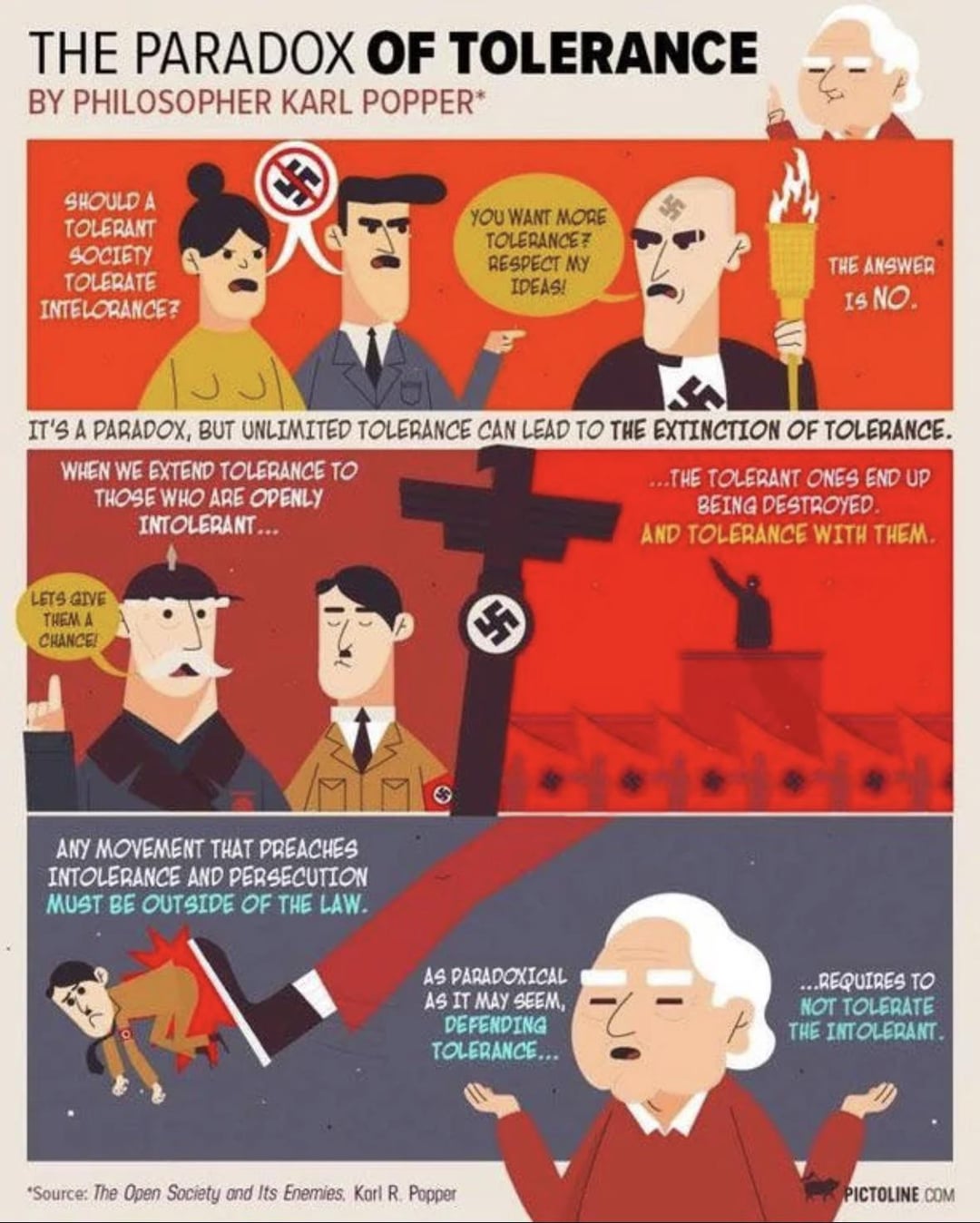
The whole confusion comes from upholding tolerance as a principle or ideal rather than actually understanding it’s purpose. When people look at it that way, they either accept it or reject it, but both of those are wrong.
Where does the idea of tolerance come from? Hundreds of years ago, the West was wracked with constant wars of religion between Catholics and Protestants, on top of witch hunts, crusades, inquisitions, the whole “scarlet letter” thing. It was after this whole mess that people decided that it wasn’t worth it anymore, and that we should just call truces, that we should allow each other to practice different faiths without coercion. Eventually, this expanded to other aspects beyond just religious beliefs, however, the fundamental core of what it is is that truce between religious factions.
In many cases, it is possible to discuss disagreements and resolve things, or, it is possible to coexist while believing different things. Whether the sacremental wine turns into the blood of Christ literally or figuratively is a perfect example of that.
However, it should be noted that this was a practical compromise driven by a balance of power between the respective sides. The word, “tolerance” should not be confused with the word, “acceptance.” To tolerate something implies that you wish it were different, and you’re just putting up with it out of necessity. It is a truce, a contract, a ceasefire, between different parties with conflicting aims and ideals. Go back in time and give either side modern assault rifles, a clear advantage, and they’d drop the idea of tolerance in a heartbeat.
When a ceasefire is violated, a certain degree of patience is called for. Itchy trigger fingers can destroy a peace that both sides are invested in maintaining. However, if one side is able to repeatedly and brazenly violate the ceasefire without consequence, then the ceasefire is essentially dead and no longer serves a meaningful purpose.
To view tolerance as a principle and ideal in itself means that you’ve already decided whether you’re going to uphold or abandon the ceasefire before you’ve even seen how the other side is acting. Accepting tolerance on principle means letting people take advantage of you, while rejecting it on principle means alienating potential allies.
Obviously, it’s impossible to tolerate the right because they are so intent on aggression against vulnerable people. However, and this is true, it is possible to tolerate different perspectives on the left, while disagreeing with them. Rather than letting one’s experiences with the right inform their approach to tolerance in general, we should look at what is actually minimally necessary to coexist and potentially collaborate with people we disagree with. Instead of logicking one’s way into saying that anyone who disagrees on any point is technically being intolerant and therefore paradox of intolerance, deplatform them and treat them exactly like fascists, consider whether they are actually being bigoted and intransigent, or whether it’s more mundane disagreement.