There’s a straightforward way to resolve the paradox of tolerance, IMO. Treat tolerance as a social contract. An intolerant person has explicitly rejected the contract.
I agree. Straightforward and simple. But I don’t think I know how to simply explain what a social contract is to someone. Does anyone have a good example of a social contract?
This doesn’t work in everybody. There’s a lot of things I like, and I would want everybody to do, that I recognize most rational people would never want.
If I followed this advice I would bother almost everybody I interact with.
The majority set the vibe. It’s ugly, but there it is. If I reject this it will only cause friction in my life. So for people like me, a better quote is:
Act only according to maxims which those affected would have be universal
Perhaps. But the same would apply to the other golden rule. It’s not “Do unto others as they would have you do unto them.”
If you do what you feel is right, it doesn’t matter if people disagree with you. You’d at least be ideologically consistent, not a hypocrite.
If being a good person requires pleasing people, there would be no good people in the world. “People” are impossible to please because it’s an abstract category representing a generalized collective. You’ll never please them all and that’s okay.
Do what you believe is right, and sleep well at night knowing you tried your best.
If I remember correctly, Kant goes into detail about how others would be affected and how that influences the categorical imperative. I forget exactly what he says about it though
If your definition is “do what you believe is right” it absolutely needs to be paired with a requirement to put effort into figuring out what actually is right.
Well when you figure that part out let me know, I’ve been trying my whole life and so far everything I’ve come up with is bound to still piss someone off…
If your definition of right and wrong is based on what gains approval from others then you’re in a very dangerous predicament and I hope to the gods I don’t believe in that you’re surrounded by decent people.
A lot of Republicans and Nazis (but I repeat myself) believed they do what’s right as a result of propaganda. What’s right is about impact, not approval.
An agreement made to be able to share each other’s space
Mutual assurances of safety in exchange for mutual acceptance of limits in regards to your shared spaces
If you break one of these agreements to others then you lose the privileges that they offered you
By demanding the benefits of a society you commit to honoring what it requires of you to maintain it
Look at stuff like the rules applied by hikers in the wilderness. “leave no trace” and sharing resources. Then you filter out a ton of the complexities of cities to show the basics of what it is.


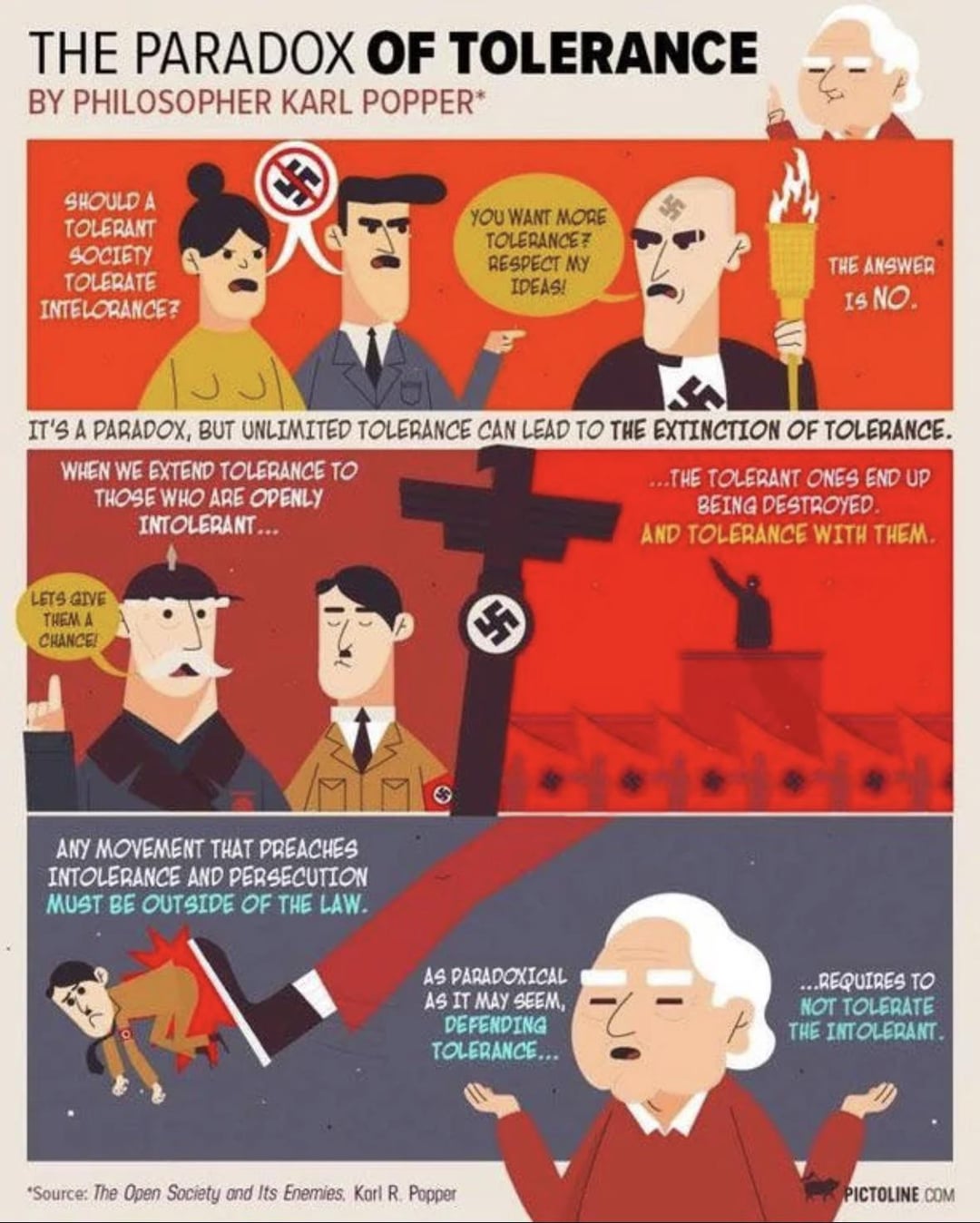
There’s a straightforward way to resolve the paradox of tolerance, IMO. Treat tolerance as a social contract. An intolerant person has explicitly rejected the contract.
Fully agree. Being tolerant is part of the social contract. If you break the rules then why should we play the same game.
I agree. Straightforward and simple. But I don’t think I know how to simply explain what a social contract is to someone. Does anyone have a good example of a social contract?
Choose to fit your audience:
Do unto others as you would have them do unto you
If you deny my right to exist, you forfeit yours
Fuck around and find out
Talk shit, get hit
You forgot one:
In other words, don’t do something that you would be upset if someone else did.
This. I’m not sure why others are arguing your point. I guess they don’t actually understand what you’re saying?
Happens all the time to be honest
This doesn’t work in everybody. There’s a lot of things I like, and I would want everybody to do, that I recognize most rational people would never want.
If I followed this advice I would bother almost everybody I interact with.
The majority set the vibe. It’s ugly, but there it is. If I reject this it will only cause friction in my life. So for people like me, a better quote is:
Act only according to maxims which those affected would have be universal
Perhaps. But the same would apply to the other golden rule. It’s not “Do unto others as they would have you do unto them.”
If you do what you feel is right, it doesn’t matter if people disagree with you. You’d at least be ideologically consistent, not a hypocrite.
If being a good person requires pleasing people, there would be no good people in the world. “People” are impossible to please because it’s an abstract category representing a generalized collective. You’ll never please them all and that’s okay.
Do what you believe is right, and sleep well at night knowing you tried your best.
If I remember correctly, Kant goes into detail about how others would be affected and how that influences the categorical imperative. I forget exactly what he says about it though
If your definition is “do what you believe is right” it absolutely needs to be paired with a requirement to put effort into figuring out what actually is right.
Well when you figure that part out let me know, I’ve been trying my whole life and so far everything I’ve come up with is bound to still piss someone off…
If your definition of right and wrong is based on what gains approval from others then you’re in a very dangerous predicament and I hope to the gods I don’t believe in that you’re surrounded by decent people.
A lot of Republicans and Nazis (but I repeat myself) believed they do what’s right as a result of propaganda. What’s right is about impact, not approval.
An agreement made to be able to share each other’s space
Mutual assurances of safety in exchange for mutual acceptance of limits in regards to your shared spaces
If you break one of these agreements to others then you lose the privileges that they offered you
By demanding the benefits of a society you commit to honoring what it requires of you to maintain it
Look at stuff like the rules applied by hikers in the wilderness. “leave no trace” and sharing resources. Then you filter out a ton of the complexities of cities to show the basics of what it is.