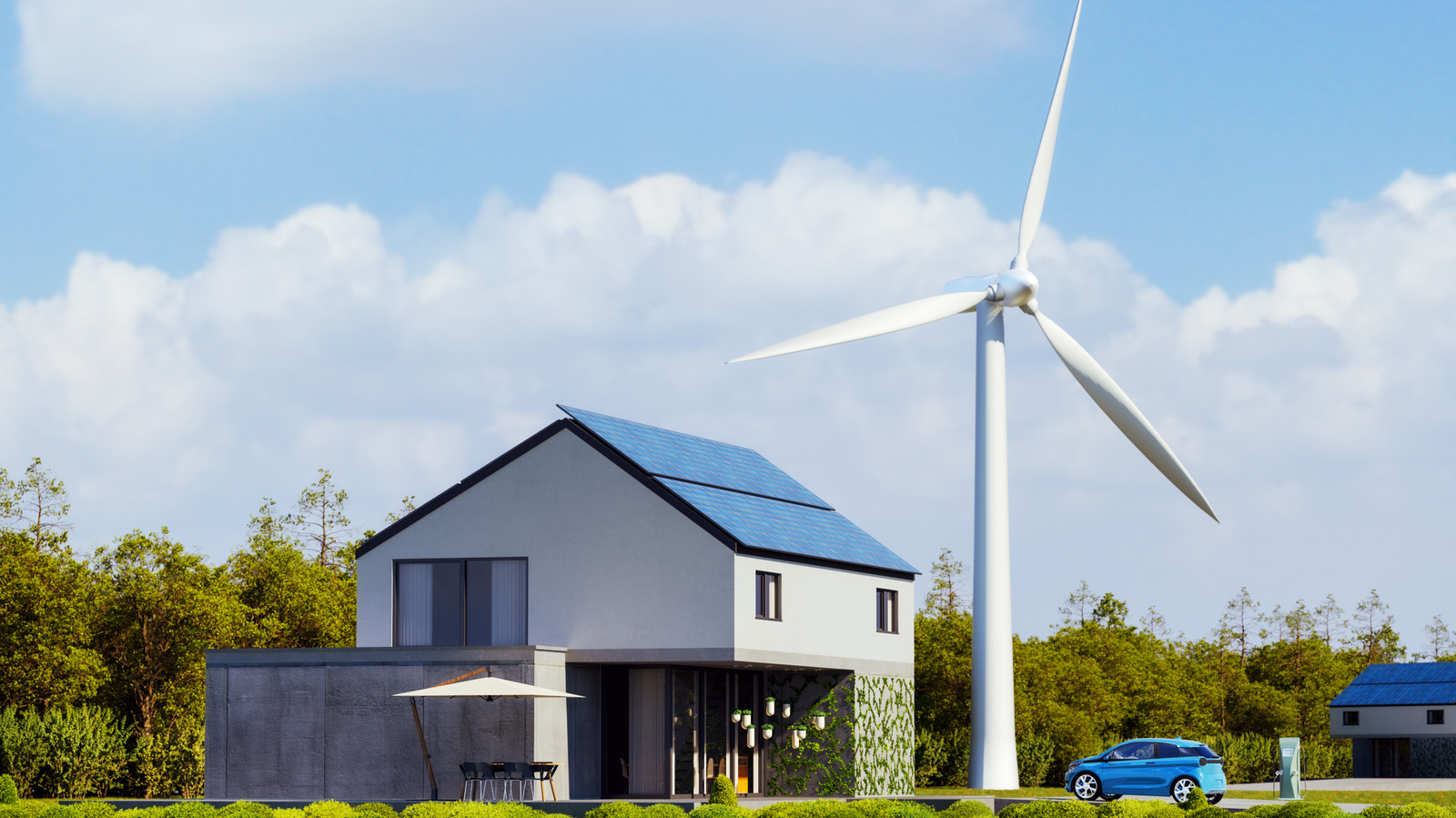
I’m guessing about 1kW
The article claims 200W average. The 1kW is to deal with gusts.
That’s also assuming perfect mounting conditions.
Well, how much if I mount it? I have some experience hanging pictures.
200Wh average per month, or 0.27Wh.
Is my math wrong or is that absolute garbage? A desktop solar panel could compete
Edit: yeah my math is garbage, solar is better (under certain conditions), but not 50,000x better
It would be closer to 4.8kWh/day. That is assuming a strong steady wind. Real world conditions would take a significant cut. Cut windspeed in half with clutter (trees, buildings etc) and you’re down to 0.6kWh/day.
Basically there is almost nowhere that wind wins over solar. At least at consumer scale.
Basically there is almost nowhere that wind wins over solar. At least at consumer scale.
Anything between late october and early march?
I can’t be arsed to find it again, but there’s a company that does solar installs in my country (which to me sounds like they’d be the last people to downplay solar’s capabilities) and they have production statistics from some of their installations on their website. I checked out a couple and May or June tended to be about 30x higher than December. I think May was actually the peak production month which in hindsight makes sense because in June the midday sun is really high in the sky and the morning and evening are somewhat more north than you’d normally get so they don’t give you much extra.
December, meanwhile, gets about an hour of useful sunlight a week.
This is only around 60 degrees north too, it’s gonna be worse for anyone that lives in an actually northern area.
In the UK it’s apparently around 4-5x better in summer. That’s a bit situation dependent. However, even at 10x, solar still competes well with wind. A useful turbine is still over 10x the cost of an equivalent winter output of solar panels. The only advantage they have is space efficiency. However, if space is that much of a premium, then it’s likely messing up low altitude wind as well.
It’s also worth noting that solar panels are effectively a rock that makes electricity. Wind turbines have moving parts. They can ice up, and have to shut down in winter storms.
I would love wind to be a viable home companion to home solar, but the maths just doesn’t add up. It’s amazing at grid scale, but crap at home scale.
Right I’m an idiot, it should have stuck out to me that I was dividing by time twice.
Per hour
Divided by not wind.
Do you mean kwh/h?
Sadly, wind power scales up MASSIVELY with blade size and height. The inverse makes it mostly non-viable for most homes.
They need consistent, strong winds to function well. Power output scales with a cube of the windspeed (2x wind speed = 8x output) and the square of the blade length (2x length = 4x output) This means they need to be considerably above everything that slows the wind down. Once you’re 50m+ above the tallest trees, you might as well just scale up the blades and go grid scale, you’ve done the hard bit.
Oh, and from the article, it’s 200W average, in perfect conditions. Conditions that almost no one can meet.
That does neatly explain why I never see small ones
I see them from time to time, usually on sailing boats or coastal beach cabins where I presume they can slowly charge a battery over a long time with probably not much power production.
On sailboats? Huh. I was just looking into converting to electric, a lot of them do regenerative charging through the prop.
Yeah, not sure what it powers. Maybe radio battery and if you are sailing you probably have wind at least.
I mean was it actually a windmill generator? I have windmill-looking things on my boat for measuring wind speed and such (they are small). It’s just that using the actual sails to pull your boat along, and then using the speed to turn a water turbine on the hull is way more efficient. Especially since there’s no meaningful difference between a motor and a generator, apart from which way the power flows.
Edit: also solar. Been waiting for reliable flexible solar panels for the sole purpose of replacing my sails with solar panels. That would be dope as hell.
Seen similar ones on holiday buildings along others with solar panels too though. Aren’t the windspeed ones much smaller? These were probably close to 1m diameter.
Yeah the windspeed ones are like. <5cm.
That’s kinda wild. Not too crazy, knowing sailing folk damn near every boat that’s over a month old has had some weird homebrew modifications done to it. Just seems like not the best plan.
It’ll run the average consumer between $20,000 and $50,000 to toss up a wind turbine. Installing solar panels with the same energy production in mind is roughly $2,500 to $3,500, and that’s before incentives are calculated in.
Spending the money on solar will always beat wind turbines for small installations sadly.
Might be nice to have both, to diversify
Probably wiser to just slap on a few more panels and add a battery for the same price
It starts sounding better when you go further north. I’m not that far north, but further north than pretty much anyone in North America as far as percentage of population is concerned. Edmonton, Canada’s northernmost city with a proper population count is still multiple degrees south of me because Europe’s climate is different and we can live further north than NA folks without our winters getting quite as bad in terms of temperature and snow. Anchorage is about a comparable latitude. But there’s an entire country (two if you count Iceland, which I forgot about) that’s located north of me and three that have more than half their landmass to the north of me (two of which also have most of their population north of me - Russia’s population centers are fairly southish). So they have it even worse than I do.
A small 3kW nominal, 5kW max wind turbine is on sale for ~1300 EUR plus VAT so around 1600 EUR. That should get you like 700-800 watts an hour, right? A 7 kWh battery starter kit that should also last you through the night at a similar drain rate for most of the year (just not in the winter when night is 18 hours and the rest of the time is barely sunny either and you need electricity the most because heat pump which is also the time of the year where electricity costs money) is about 4k (VAT included). At this level, the batteries and solar might still sound good, because wind turbines are annoying and big and not that efficient at home usage scale.
Now the other problem is that the panels that would take a day to fill that battery pack in a day in the summer would take nearly a month to fill it in the winter. It’s not JUST fewer hours of sunlight, the sun angle itself is super low. So you’re going to need a fuckton of panels.
In the end, if you want to stay on your own power reliably (e.g because you have a heat pump for heating and you live in an area where a power outage could be several days) and you get short winter days with barely any sunlight like I do, that turbine starts sounding pretty darn good, it’ll be an order of magnitude cheaper, though you should still have SOME battery. It’s just that if I wanted to power my house all on my own produced electricity, and heat my home with a heat pump (ideally geothermal because less energy), with only solar + battery, at ~2 kW of power into the geothermal pump, an 18 hour night is 36 kWh of battery required. There’s like an hour or two of actually useful sunlight a day and a few hours of “the sun technically exists”. Then up to 18 hours of darkness. If I add a wind turbine to my hypothetical solar + battery array, the battery capacity doesn’t need to be nearly as big.
This is only really required, though, if you want to be entirely self-sufficient. If you live in a town where you can rely on the grid being functional 99.9% of the time and are OK with using something dirtier than coal for your main electricity source at night, you’ll be fine with much less and the wind turbine sounds useless again. It’s only in my “oh I’ll go all green and all self-sufficient” fantasies where it’s useful.
The below text I marked as a spoiler so it can be ignored because it’s my ADHD ramblings on what I envision as a future utopia if there was tech and funding for this. It would reduce the need for wind turbines even on grid scale and everyone could have green energy without having their own production unless they need it for reliability.
spoiler
What would actually solve this once and for all, though, is if we solved mass long distance power delivery to a degree that it could span continents. Sunset in my country, depending on your exact location of course, on Dec 23 is around 3:20 PM, UTC+2, so 1:20 PM UTC. In Lisbon on the same date for example it’s 5:19 PM UTC. If that part of the continent produces more than it consumes during that part of the year, then we could benefit from that to get more green energy when it’s the hardest to generate in our region. In the summer, however, we’d be providing electricity to this continental scale grid starting at ~1:04 UTC on June 23rd for example, as our sunrise is 4:04 local time in the capital, with cities like Narva being even earlier. That’s about 4 hours before the southwest of the continent gets its sunrise. If southern Europeans want to run AC all night long in the summer, we’d be the ones making that possible without fossil fuels. Just connecting all of Europe + having tons of batteries all around would be a game changer if this was possible. Fossil fuels wouldn’t ever really be needed here. If it was then possible to expand this to Asia and Africa, we’d have a much wider profile of sunlight hours in the mix. Africa would help us a lot in the winter, whereas we could benefit them as well during summer evenings and mornings when they have shorter days than we do. Asia would get us so many hours where we have no sun and they have plenty - and of course, vice versa. It could even be feasible to connect Australia and maybe NZ through undersea cables from Asia. The Americas through the Bering strait. Remote islands would unfortunately most likely lose out, though.
This is my dream utopia. Of course beyond the tech required to do this (superconductors that don’t stop working when it’s 50C or more in the sun or at least whatever temp they’d be at in the ground when buried), we’d also need some countries to play ball that aren’t currently being very reasonable. At this rate, I think we’re closer to getting fusion producing usable energy.
Since this isn’t feasible in the foreseeable future, what I think will help things in the meantime here in northern places is home (and ideally grid-scale) battery storage of grid power in the winter. Since power can be cheap some hours and expensive other hours, people with batteries can make use of that to buy and resell energy they didn’t actually produce themselves. As this smooths out supply and demand, it makes unpredictable wind much more predictable, and reduces need for our shale plants to run, which they’re already not doing very well in the winter which is why we can get massive electricity price spikes in the first place. I also think wind farms themselves could use batteries to be able to time their supply to the grid if they don’t already.
Solar is more useful in the north than it may appear at first glance, because of longer sunlight hours during the summer. And because ambient temperatures there are lower, so modules operate at a higher efficiency. There vertically mounted bifacial modules make a lot of sense. There is no snow accumulation on them and if not north-south aligned the start proding earlier in the day and stop producing later in evening.
For seasonal load leveling it would make sense to store hydrogen from water electrolysis from energy surplus harvested during the sunnier parts of the year.
Yeah, but for the price of 1 turbine I can duplicate my solar setup.
Indeed. My point wasn’t that wind is better than solar. But having both is nice. Solar isn’t available 100% of the time, and if the periods of low solar are longer than battery capacity, then you wind up back on the grid.
Diversifying your power sources means that even if it’s cloudy, you still have wind. Is it a good idea financially? No. Is it a good idea if you are committed to the idea of maximizing time off the grid, yeah. Cost per kWh isn’t the only factor in why someone might want home power.
I’m doubling mine today for the huge price tag of about 500 EUR. Bringing me up to 4 kWp, which is well over 100% of my net use.