
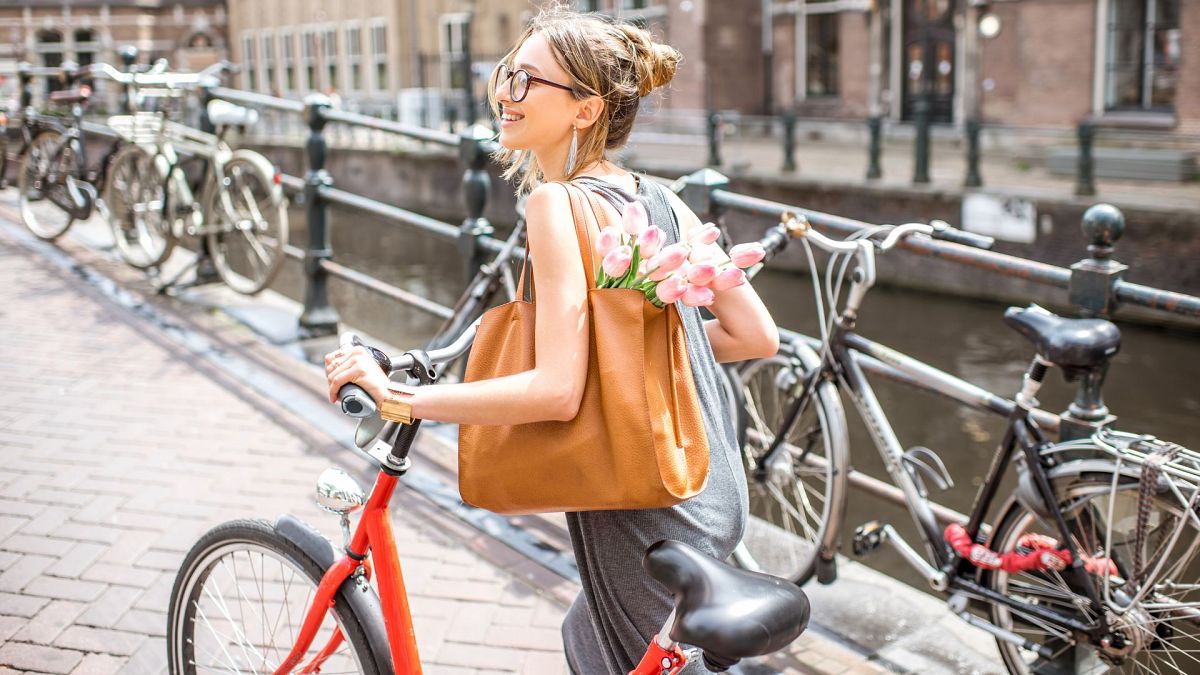
Dutch people cycle an average of 2.6 kilometres each per day. If this pattern was replicated worldwide, the study suggests, annual global carbon emissions would drop by 686 million tonnes.
This mammoth figure exceeds the entire carbon footprint of most countries, including the UK, Canada, Saudi Arabia and Australia.
Having to only go as far as the Dutch for travel would be helpful for transitioning to bicycles. The moment American city distances ( hundreds of km) are applied, everyone scraps bikes. Buses and trains and cars and planes become the conversation - bikes aren’t realistic for actual travel but nice for local commutes like groceries.
Spreading out like that was a deliberate choice on the part of American city planners. It was an unnatural experiment that failed, and which can and should be undone.
https://archive.strongtowns.org/journal/2015/1/7/americas-suburban-experiment
Are you suggesting time travel as a solution?
Bike lines to commuter hubs for mass transit is the answer I’d go with, personally.
No, I’m suggesting zoning law reform. Right now, it is very often literally illegal to build in a sustainable way, and that has to stop.
I agree with that, but sorry I don’t understand how thats related to biking more and mass transit, other than a complete rework of the layout of towns and cities across the country that would take decades or more to have an impact.
The rework is the suggestion, I think A gradual rework would already help and wouldn’t take that long. It’s just that somebody would have to start that, and I am not sure if the will for that exists.
I would have to disagree on it taking that long (as in so short) - not the change to zoning law, but the actual existing building infrastructure.
Cities are one thing, and often have better infrastructure in place (though absolutely not a guarantee), but general suburbia you wouldn’t find much shift in a short time. For one, availability of sites for new construction, and two, its the most likely place for quick capitalist change (new expensive clothing store rather than say, a small grocer).
Its going to get harder the further rural you get, there is more space but won’t be as much appetite. Small businesses had already been squeezed out by the likes of Walmart and their ilk, and wouldn’t sensibly be able to return without other changes (like being low cost enough and affordable to the local folks to go there instead of a Walmart Super Center or whatever those giant warehouse mini mall ones are called), which means financial incentives and lower and middle class folks having more money to spend.
Which you’d need to start having people stay more local for work to grow the local community.
Its a part of a solution, but it isn’t a solution by itself IMO. And its going to take time to have an impact. Time that will be on a decades-long scale, considering many towns have been around for a hundred years or more that isn’t a staggering timeframe, its sensible.
It definitely can’t be done in the same kind of timeline as bike lines and bus infrastructure.
(Edit: stupid mobile keyboard)
It is true that the US has a loooong way to go. It’s insane to me that even the most progressive among y’all don’t even see the point of starting this journey.
You might be surprised at how much pent-up demand for density there is in the inner suburbs (the ones old enough to still have been built on a reasonable grid system instead of cul-de-sacs).
People really gotta start saying what they mean by “density”, because I’ve had 4 people in 700sqft, and cannot imagine people actually want to live like that.
When people complain about lack of density they’re complaining about 2 people living in a 4500+ sq ft suburban house with an even larger yard.
I’m not, I just don’t think there is that much by comparison to the huge swaths of the rest of the country.
For the record, I’ve lived in city, suburb, and more rural, and have spent long periods of time in really rural (like a town of 200 people that my mom has family in, and a not-even-a-town where its just 50+ acres of woods between everyone’s home and its only 20 minutes by car, on roads with no speed limit, to reach the highway).
The time scale for those sorts of changes is long, and need other changes to make it work.
I suggest fixing what you can to stave off an even worse climate catastrophe. It’s that or go extinct. I am sure the USAians will make the sensible choice.
Cars have only existed for ~150 years, American cities are mostly older than that. Spreading out was a choice but it wasn’t because of cars.
At one point in time 100 years ago you could take commuter rail systems all the way from NYC to Cincinnati. Those systems were removed 1950s and then the bus companies that removed them ‘mysteriously’ stopped having so many routes (many were owned by GM…).
150 years ago, most cities were a bunch of unconnected small towns surrounding a central smaller city. They slowly grew together into the sprawl we have today.
The transcontinental railroad was completed in 1869 and again that’s not even talking about the commuter rail systems that I was mentioning before. You could take a train from New York to Philadelphia in the 1830s. Car companies want you to forget just how connected we used to be.
Uh…you can take a train from New York to Philadelphia today and it leaves like every 20 minutes. Two a day from New York to Cincinnati, but 19 hours. Car would be half that, airplane a fraction. I think it’s less conspiracy and more convenience…
They didn’t have cars or airplanes 150 years ago… but they did have trains.
What complete nonsense. The suburban sprawl of the US is a relatively recent phenomenon that definitely happened after cars had become widespread.
So I live in one of America’s oldest streetcar suburbs, from the 1890’s. They had horse-driven streetcars since the 1860’s or so, steam from the 1870’s, and electric ones from the 1880’s. LA’s urban sprawl is entirely due to their historic streetcar system. The person you’re responding to is basically correct…
I mean… It’s not like Dutch people use their bikes to go between cities (maybe sometimes, but they got buses and trains, too). The bikes are for local trips, which make up the vast majority of trips you’ll do. It sure helps that cities in Europe are laid out in a less spacious manner, but that’s not an unfixable situation for the US.
The car desert that is suburbia can be split into micro cities (perhaps with bike friendly trains) with a few local food supplies and necessary services. Far from impossible with a cultural mind shift.
10-20 km is an easy bike commute distance if the infrastructure allows it. Especially with electric bicycles. I’d guess that most people in the US don’t travel more than that for their daily routes.
deleted by creator
I wouldn’t say easy. 20 km takes me an hour or more, although I am slow and don’t have an electric bike (yet).
Let’s be real, we have long since given up on USAians coming to their senses. But the rest of humanity might like to save themselves still.
But how much “actual travel” do you do? Most of my travel is urban, where cycling tends to be the fastest and most efficient option when you factor in traffic, parking dilemmas, etc.
I’d say outside of 2-3 months in the winter, I make around 80% of trips by e-bike. The car is still there when I need it. I guess what I’m trying to say is it’s not an either/or proposition.
For me, actual travel is 35 miles every day. Uphill elevation change over that distance is 800ft-1500ft depending on the direction.
Most places in the US never considered biking as a valid travel method when being designed.
Is that 35 miles round trip or one way? If it’s round trip, that’s actually not so bad. You’d clearly need an ebike to handle those climbs though.
Also, I don’t know your situation in terms of whether you could take trails or cut through parks to reduce the distance? I sat down with google maps and figured out a shorter route for my commute. It actually involves more climbing because there’s a ravine trail I follow now, but that’s not an issue for the ebike.
That’s round trip mileage.
An e-bike would be nice, but would definitely add commute time. I commute via motorcycle most days.
I have regularly commuted by bicycle when living in The Netherlands, England and Germany and bicycles are really only for traveling inside the city not for going between cities.
Back when I lived in The Netherlands at one point I had a bicycle at home and another parked at the train station on the city where I worked, so I would commute to the train station nearest to were I lived using my home bicycle, leave it there, travel by train to a different city, pick up the bicycle I had there from the train station and use it to do the last leg to get to work. At the end of the day I would do the reverse.
Even having a bicycle to cover just 1 or 2 km is quite a time saver (easily turning a leg of a journey that takes 15m walking into one that takes 5m).
That said, I could do it like that because in The Netherlands there are proper parking places for bicycles at all train stations plus trains are pretty good.
When living in London (which at the time seriously lacked good conditions for cycling) I just used my bicycle to go from home directly to work, which was maybe 4km, took me around 23 minutes and was actually faster than using the Tube (the subway), whilst in Berlin it was sorta the same length of ride but from where I was living to were I was studying.
Obviously in all those places the bicycle was also useful for things like doing my weekly shopping (just get some bicycle bags).
Mind you, having a bicycle doesn’t exclude also having a car, though I never really got a car in Germany (I was there for 3 months only, living and studying in Berlin) whilst in London I actually ended up selling my car because it was just a massive money drain (especially because in the last place I had to pay for a garage) which I barely used since even without a bicycle, public transportation is excellent when living inside in or near the core of the city (so, Zone 1 - 3).
The Netherlands is also one of the flattest countries in the world. We should still all cycle more, but it would require much more effort to cycle 5km in San Francisco or the Himalayas than in the Netherlands.
And of course it’s your responsibility as opposed to the people designing infrastructure, the politicians approving their plans, and the corporations lobbying the latter
/s
People shit all over 15 minute cities. I miss it moving to Canada from the UK.
Why do they shit on them? I love them.
Because they think it’s a conspiracy to eventually lock people down into their 15 minute block and not let them leave. Once 15 minute cities have been established, they’re going to create another “plandemic” like COVID to initiate another lockdown.
Not kidding. Source: my family
I don’t even understand the logic behind that one. Although looking for logic might be optimistic.
My guess is not enough bathrooms.
Rebuild the whole of society, place affordable houses around work centers and we could.
Cities need to be build around this concept
They were. America bulldozed them. Just do it again
*Car companies bulldozed them. Around the same time they bought up all the trolley systems, and then shut them down.
there is NO solution to climate change that doesn’t involve a > 80% reduction in car use (and banning flying) Even the IPCC has said e-cars aren’t an answer (they embed urban sprawl).
There’s is a persistent myth that we can’t inconvenience anyone, which is patently nonsense as the destruction of civilisation from climate change is more than inconvenient.
People are not going to give up their comfort. And that is the problem. It isn’t just cars it is rampant consumerism that is a problem and nobody is giving that up.
They are going to give up their comfort. They can choose to do it before civilizational collapse, or after.
The Dutch also have a very flat country
They make ebikes now that really help with hills
As someone who’s relatively recently started riding a motorcycle I feel like at that point skip the half measure and get an electric motorcycle. Really don’t get the focus on bycicles in these discussions since I feel like it’s liable to make people think it’s a lost cause in areas like mine where the city is quite literally on a 20 degree slope minimum.
Wish I had an electric motorcycle to a degree but the 40 year old 110 is far more workable with what I intend to do with it what with reserve fuel and whatnot. Is it insane to plan a trip from SoCal to Washington on a 40 year old motorcycle? Yes. Will that stop me? Fuck no. My first trip up there was with a slowly dying 95 four runner I’ve got to up the standard set by 19 year old me.
True, but 4 hills = 20 miles.
That doesn’t get a lot of snow.
Oulu (Finland) is pretty big on cycling and they get plenty of snow
If everybody cycled as much as the Dutch, global carbon emissions would drop by nearly 700 million tonnes per year.
For context, Wikipedia puts annual global carbon emissions in 2023 at 39,024 million tonnes. That’s a 2% slash. I suppose if you find a lot of these it could add up, but without a fix for the original problem of unregulated capital expansion it’s just going to fill the void.
For context, aviation is also about 2% of emissions. So it really isn’t nothing.
But the lower-hanging fruit for me is all of the kerosene used to cook. That’s also about 2% of global emissions and it’s a good candidate to be fixed with solar panels and wind turbines.
By the Allfather id kill for a good quality electric stove for camping. At least on the same durability and reliability as my propane/ butane one.
Or - we could just say it’s illegal for these billionaire crybaby warcrime shitheads to fly like they do. Same emissions savings, and the world gets infinitely better.
redesigning cities to be more bikeable (and less car centric) would have an infinitely better effect on your quality of life than stopping billionaires from using private jets tbh
not that we shouldn’t do both, obviously. we should prevent billionaires from existing in the first place even
Yeah there’s like 25 000 private jets in the world. This is scandalous, this should be 0 one way or another, but it’s not to scale with the problem.

Why is it always Taylor Swift and not like other top 100 billionaires which I’m pretty sure use way more than her
- Woman
- Celebrity
- Not a Nazi
So she’s a target
I will gladly use another meme if you provide one.
https://www.gimp.org/downloads/ it should be easy to change the name yourself
That’s not providing another meme.
It’s an and not an or type of situation. Stop clinging to your car like a baby to its pacifier.
Weird personal attack. How do you know I even drive?
Relax weirdo
During COVID, global use of cars dropped by at least 50%. Total global emissions dropped 5-10%. The largest container ships create more emissions annually than every car on the planet. And I’m pretty sure that that’s per ship, not combined.
67% of emissions are caused by 100 companies. The top 1% of people create more than the bottom 50% of the planet.
Individual responsibility was created as a propaganda tool to allow companies to continue their environmentally destructive habits by passing the blame for industrial waste being dumped in forests on people not recycling their styrofoam burger packaging. The same way that fatal pedestrian accidents with cars was passed onto “jaywalkers” by the auto industry. Just like this article is doing.
Stop defending billionaires.
I’m all for more biking. I will remind everyone that the Netherlands is almost completely, absolutely, flat. probably the most conducive place for biking in the entire world
I think this is the biggest thing. Everyone’s complaining about weather like you cant just dress for it.
The biggest thing is that the biggest hills you’ll get in the netherlands are when youre going over a bridge over the canals. Otherwise the whole place is below sea level.
Still though, we can definitely make it easier and better for bikes around the world.
But you forget: the wind is against you both ways!
Only partly a joke. I have a job in N Holland once, way up, and my commute was directly North-South. The prevailing winds come from the West, BUT usually the started off SW, against me, then over the course of the day changed to NW, again against me!
Hate that job anyway.
I think this is irrelevant now that bicycles with electric motors are so common.
200m climb per 10k is also very doable.
I always say my “dream car” is good public transit and walkable cities with good bike infrastructure.
It might not work everywhere, but it’s a nice goal and it would have the secondary effect in America of making most of us a lot healthier.
It’s also fun. I always have a smile on my face when riding back from a grocery run or dinner out. Driving a car used to just make me aggravated.
Yeah I’ll often walk a mile or two (and back) for an errand or appt because it’s more pleasant than the driving/parking. Drivers are always stressed (kinda reasonable when you’re operating a dangerous and expensive machine, but not pleasant).
Would also make people much healthier.
And that means a lot of indirect reductions in carbon emissions from health-related industries
but what’s in it for the shareholders?
Strong legs?
I was hoping it would be weight loss via a certain device
Lots of money in selling bicycles?
I am strongly leaning toward beginning to take practical steps to someday move to the Netherlands because, even ignoring the ugly US political climate (which let’s be real, is probably not going anywhere good anytime soon), I came to realize as a bike commute lover that I will always be miserable in this country unless I relocate somewhere where I can bike more freely.
Sidenote: a vegan who drives has almost as low of a footprint as an omni who is full time car-free. So why not both? Whatever you can do for where your life is at, the more plants you eat and the less animal products, the more worthwhile you’ll find it to be.
Then build us cities like the dutch.