The trick is that there is no paradox, only the implication of one. ‘If’ being the key word - you’re not actually being asked to answer randomly, but you are being subtly trolled.
You do not need to pick at all for the paradox to exist. If either A or D is correct, the other is also correct, and the random odds of selecting the correct answer should have been 50%. This is a contradiction. Neither A nor D can be the correct answer.
If B is correct, the random odds of selecting it is only 25% - a contradiction, so B cannot be correct. Likewise, if C is correct, there is a 25% chance of randomly picking C. C is also not correct.
None of the four answers is correct, so there is a 0% chance of randomly picking the correct answer. C is correct, contradiction, C is not correct, C is correct, is not, is too, etc.
The paradox is resolved by knowing the the scantron answer key has A selected. D is not sufficiently identical to A in javascript, so only the students that randomly guessed the correct answer will get credit.
Because the paradox can only be resolved with either A or D as the selected answer, well informed students picking randomly would have a 50% success rate.


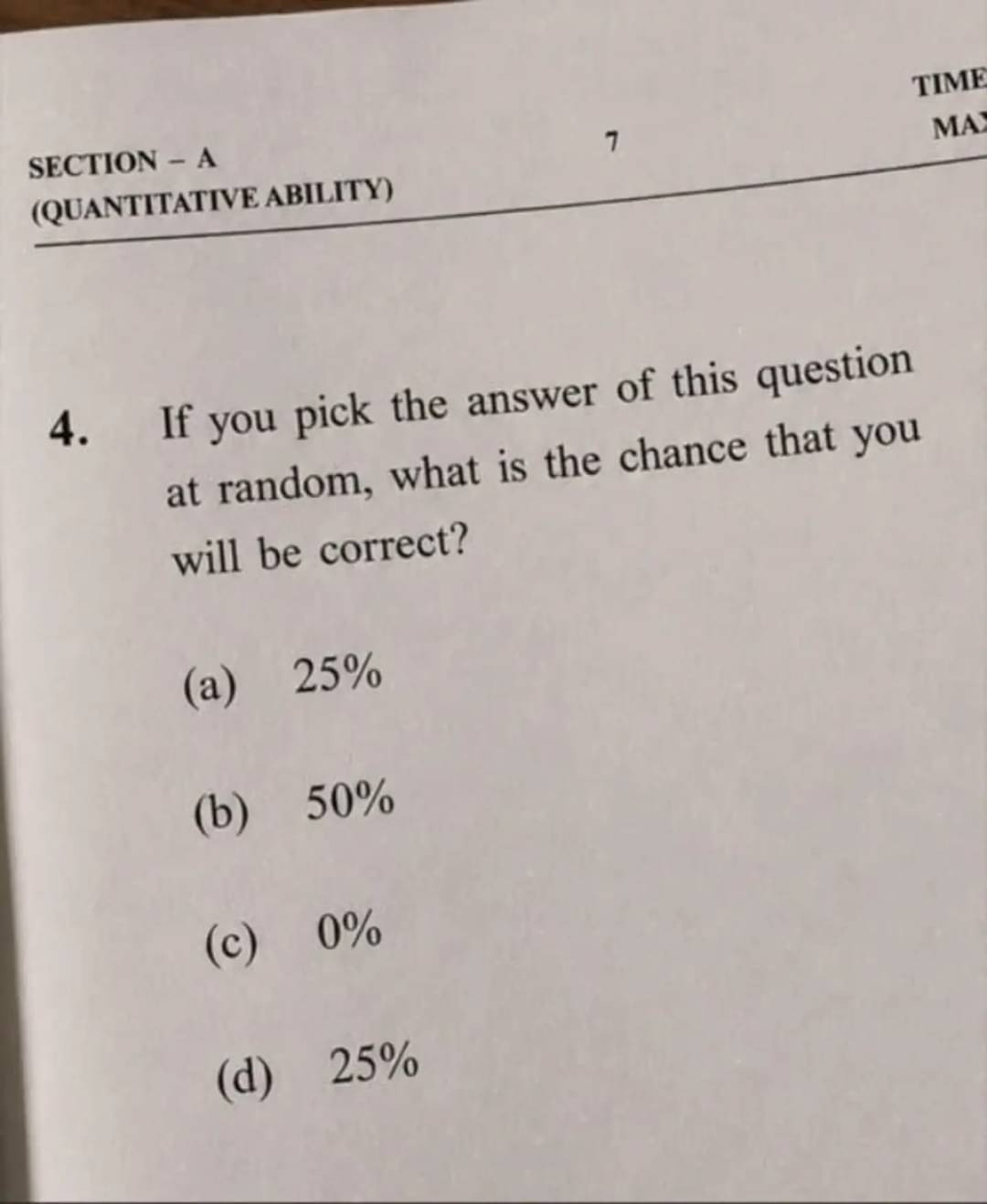
The trick is that there is no paradox, only the implication of one. ‘If’ being the key word - you’re not actually being asked to answer randomly, but you are being subtly trolled.
You do not need to pick at all for the paradox to exist. If either A or D is correct, the other is also correct, and the random odds of selecting the correct answer should have been 50%. This is a contradiction. Neither A nor D can be the correct answer.
If B is correct, the random odds of selecting it is only 25% - a contradiction, so B cannot be correct. Likewise, if C is correct, there is a 25% chance of randomly picking C. C is also not correct.
None of the four answers is correct, so there is a 0% chance of randomly picking the correct answer. C is correct, contradiction, C is not correct, C is correct, is not, is too, etc.
The paradox is resolved by knowing the the scantron answer key has A selected. D is not sufficiently identical to A in javascript, so only the students that randomly guessed the correct answer will get credit.
Because the paradox can only be resolved with either A or D as the selected answer, well informed students picking randomly would have a 50% success rate.
But why is C a contradiction? I’m not randomly picking it.
Because your c is their c. If you were right then those randomly choosing test takers are also right.