The trick is that there is no paradox, only the implication of one. ‘If’ being the key word - you’re not actually being asked to answer randomly, but you are being subtly trolled.
If you ignore self-referential nature of the question and stop the iteration at some point, sure, you can argue that any answer is correct.
If you ran a infite monte carlo test on it, you’d end up with 0% correct answers.
That would mean your Monte Carlo test is set up incorrectly because at least 1/4 of the results of the test would be the “correct” answer as per your own argument, thus invalidating it.
Nah it’s a paradox. There’s no such thing as just a freestanding Monte Carlo test that you can just “run” - you do actually need to define enough parameters to make it tell you anything.
This kind of self-referential stuff feels like a proof of Gödel’s incompleteness theorems with extra steps.

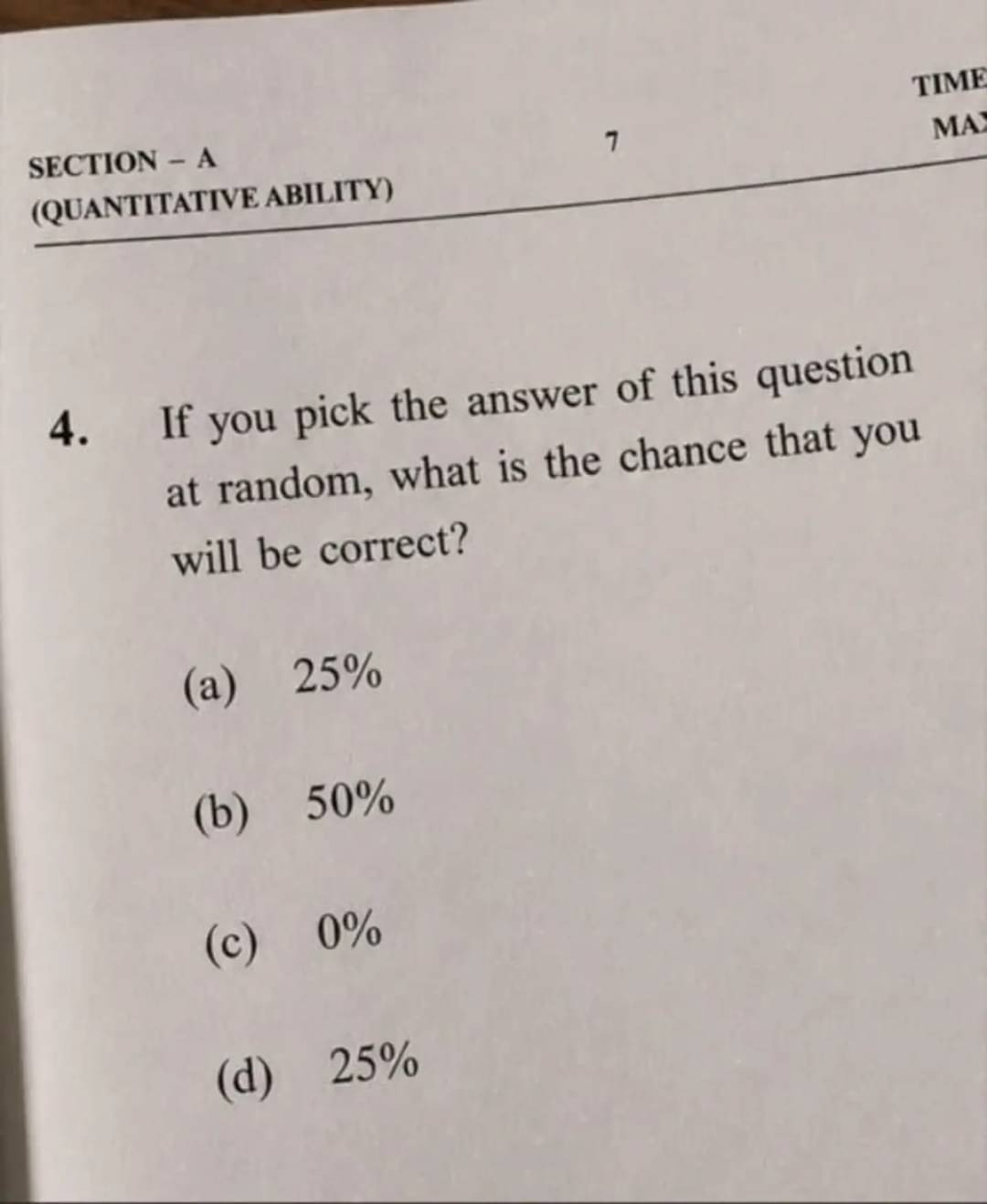
Couldn’t you argue that 0% is correct?
It’s a paradox, no of the answers can be correct, so the chance that you pick the correct one is 0%.
Sure, by picking it, it makes it wrong, but you don’t care about that.
If you ran a infite monte carlo test on it, you’d end up with 0% correct answers.
Sure, picking the zero makes it not true again, but you don’t care about that - it prooves that the statistical test holds.
The trick is that there is no paradox, only the implication of one. ‘If’ being the key word - you’re not actually being asked to answer randomly, but you are being subtly trolled.
If you ignore self-referential nature of the question and stop the iteration at some point, sure, you can argue that any answer is correct.
That would mean your Monte Carlo test is set up incorrectly because at least 1/4 of the results of the test would be the “correct” answer as per your own argument, thus invalidating it.
Nah it’s a paradox. There’s no such thing as just a freestanding Monte Carlo test that you can just “run” - you do actually need to define enough parameters to make it tell you anything.
This kind of self-referential stuff feels like a proof of Gödel’s incompleteness theorems with extra steps.