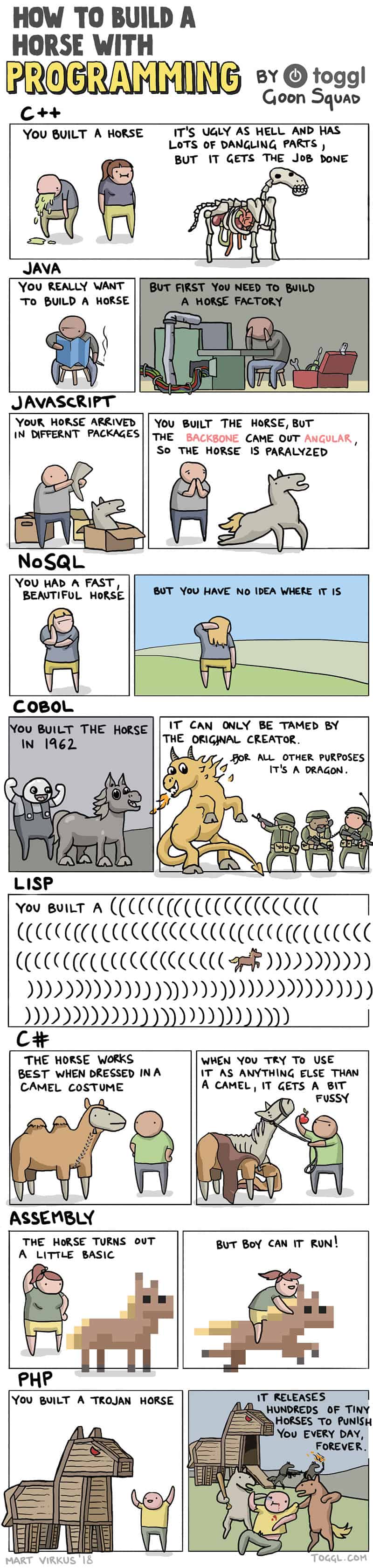
you could say that it aged well
As a non-programmer, TIL Java and JavaScript are two different languages.
Person1: I built a script in Java.
Person2: So Javascript?
Person 1: NO!
When JS was being developed, Java was all the rage and it merely was riding it’s coattails. At the time of its creation it was nothing like Java either.
Rust builds a unicorn
ho-rs
Is it a dig against C# only being good when using it from F#, i.e. OCaml for .Net or am I overthinking this?
I don’t know. I thought it was a dig with certain C# dev products trying to mimic how other technologies behave, like WebForms.
Python:
from horses import Horse

my_horse = Horse(color="brown")
There. Done.
horseswas last released in 2024, and can only run on python up to 3.12.horsesdepends oniron-making, that is up to date. That means the current version ofiron-makingdepends on python >= 3.14, and that all the versions prior to 2025 were taken offline due to a CVE where if you run the library as root in a web backend that uses themake_nailfunction, people can open your barn doors without authorization when inside it.and also the most recent
horsesrelease on pypi includes a crypto miner and credential stealer.I cannot up vote this enough.
thanks, I hate it
You built a horse in Python. There’s too much space between you and the horse so it dies.
I’ll just instantiate a new one.
Or you accidentally used spaces instead of a tab on one line
Your horse is now an upside-down zebra
In Nim:
import horses

let my_horse = Horse(color: "brown")
When I first saw this comic I was a relatively new COBOL programmer. It felt accurate.
I am now my employer’s senior COBOL dev. It still feels accurate.
What’s the biggest hurdle to porting old systems written in COBOL to newer languages? Besides the glaring conflict of interest for you.
Mostly it’s two things:
-
COBOL is very good at some specific things that other languages can’t do as well. Not that other languages do them badly, not at all, but COBOL is absurdly efficient for certain operations. You need to do basic math operations on millions of rows of data every minute? COBOL can do that easily. Many other languages can get close to that speed - maybe a few seconds off - but COBOL is often used in environments where a hundred millisecond delay can mean everything breaks. Are there other languages which can match that speed? Absolutely. Are they any of the languages every company wants to upgrade to? No.
-
COBOL’s best practices are sometimes the literal opposite of what every other language expects, especially when it comes to optimizing code for efficiency. You ever seen Evaluate, COBOL’s equivalent of a switch statement? Rather than being used to Evaluate a variable to check its values, its most commonly used to “EVALUATE TRUE” and then use the WHEN clauses (basically case statements) to check statements or variables that you want to be true. That can be converted to another language directly, yes, but it absolutely will not be efficient best-practices code. Most likely you’re going to need someone - not an AI, not an automated process - to do one-off rewrites to keep the code performance the same. As it is I have never seen any automated tool (LLM or otherwise) convert COBOL without falling victim to this issue.
There’s also a third issue in that COBOL has some specific minor capabilities that other languages just do NOT, or not to the level of flexibility and efficiency COBOL has. The most common one is COBOL’s “88” picture type (variable) definitions. Think of it like being able to set an automatic evaluation on a variable that returns true if the condition is met, e.g. the variable “05 WS-ERROR-STAT PIC X.” with an 88 of “88 FATAL-ERROR VALUE ‘F’.” would mean you could check “FATAL-ERROR” anywhere in your code to see if the value of WS-ERROR-STAT has been set to “F”. The thing is, this is done basically for free (resource wise) as part of allocation, and furthermore it can be used to get or set, i.e. “SET FATAL-ERROR TO TRUE” will change the value of WS-ERROR-STAT to “F”. You can also use 88s for ranges, e.g. “88 ANY-ERROR VALUES ‘F’ THRU ‘N’.”, though you can’t use them for set operations that way.
Bottom line: there’s nothing that perfectly recreates its efficiency, the specific way it performs efficiently, and some of its more esoteric capabilities. Anything still running COBOL probably depends HEAVILY on one or all of these things.
-
Hahaha port. Get a load of this person thinking COBOL is being ported! I bet they like the number 4.
I think just the size of the projects. My employer has had a team of ten-ish people working full time on porting a piece of our COBOL program (the full thing was deemed not possible to port to a single modern application, so it’s getting split up) for about a year now. I was peripherally involved in four rounds of increasingly integrated testing environments. Go live was yesterday. They rolled it back three hours in.
It’s hard for a company to invest multiple people’s salaries for many years on reworking software that currently mostly works.
the cobol system was already tested for years or decades, important bugs are already fixed, it’s other quirks have became part of the workflow for people using it, and for other systems interacting with it, some of them likely also cobol. if you write a new system, it has to work the exact same way. same features, same bugs, same everything. but realistically it will have brand new bugs, it will miss some functions and do some others differently enough that it sometimes causes problems, and nobody knows why.
Needs a python horse in there.
Probably something about “why build a horse when you can just
import horse from field?”“The horse turns out perfectly average, but boy it can’t run”
But it still gets there faster than all the other horses on account of how easy it was to implement.
Sadly, it gets so long to go from point A from B that you wish you made the horse in something else…
But it’s built 10 years ago using conda so the installation process is more complicated than building a new horse.
horse()from field import horse*Well don’t I look like a grade-A moron now?
This is no time for joking around…I just wanna know if I can turn my webserver back on yet?! Hello?!? Anyone?!
If you keep it off, it’s significantly harder to get hacked.
Until your hosting service gets pwned…
In Horse64:
import horses from horses.horse64.org

func main {
    var my_horse = horses.Horse(color="brown")
}
And in Horse64 Root:
import horses from horses.horse64.org func main -> bool { var my_horse <- horses.Horse my_horse.init("brown") if failed(my_horse.init) { return no } defer my_horse.destroy() my_horse.run() if failed(my_horse.run) { my_horse.stop() return no } my_horse.stop() if failed(my_horse.stop) { return no } my_horse.eat("hay") if failed(my_horse.eat) { return no } return yes }Ctrl-F “rust” - > 0 matches
I sense a pertubance in the force
Well duh, Ctrl f doesn’t work on pictures!
…yet. Then again, that’s literally what “alt” on images is for.
The LISP parentheses are not equally balanced. There are more ( than ).
Exactly 6 more.
)))))) There, the horse is contained now.
You thought so, but there was a teleporter
Shout-outs to enclose.horse!

This might be a client issue, eg: when images are too big, Thunder pixelate 'em


It is indeed, thank you!
Good to know. 🙏
Looks big enough to me.
Well, this is the original as it gets, direct from the source.
All right. Sorry if that came across the wrong way: I wasn’t actually trying to complain, I just used the meme because I noticed the low resolution. I don’t know if I’m getting too old for this crap, but back in the day, that meme used to pop up all the time as a response to low-resolution images. ^^

The resolution is great on my end. That might be where the confusion was
Nah, that’s ok. Though you have to click on the image for full resolution. On Lemmy it shows small for some reason.
Oh, didn’t realize that, thank you!
No problem!
Thanks!
The Fixed Point Expression / Y Combinator expressed in horses:
    Y = (λ f. (λ x. f(xx))(λ x. f(xx)))
    ;; so then, give Y a horse argument with apple parameters:
    Y🐎️ = (λ f. (λ 🍎.  f(🍎🍎)) (λ 🍎. f(🍎🍎))) 🐎️   ;; [1]
        =       (λ 🍎. 🐎️(🍎🍎)) (λ 🍎. 🐎️(🍎🍎))      ;; [2]
        = 🐎️(   (λ 🍎. 🐎️(🍎🍎)) (λ 🍎. 🐎️(🍎🍎))   )  ;; [3]
        = 🐎️(Y🐎️)                                       ;; [4]
Explanation
- 1: x is 🍎, but could be anything. It’s just a function parameter nested within another.
- 2:
λfgets executed and vanishes from the left, substitutingfinternally with🐎️. This is now a new function, with left group as the function body, and right group as the function argument, despite being identical. - 3:
λ🍎gets executed and vanishes from the left, substituting🍎with(λ 🍎. 🐎️(🍎🍎)) - 4: Everything within the main brackets at [3] has been seen before at [1], but with f being 🐎. Thus we have bred a new horse. We can breed infinite horses this way
And here I am glad that I try to avoid phpMyAdmin too, whenever possible.
But notice that lisp was the only one where you actually built a horse.
Also assembly. And the dangling parts.