Maersk, working with the British wind propulsion company Anemoi, plans to test the feasibility of wind-assisted propulsion on one of its smaller conta...
You’re right it’s supposed to work like a sail. I’m very sceptical because it says it can save up to 30% fuel. No chance any sail with that footprint can save that much fuel. At least with electrical generators you can benefit from wind in any direction at any time, even when anchored.
I’ve heard they work well. Something about the magnus effect produces thrust. I forget the details, but it doesn’t function at all like a traditional sail.
It’s more efficient than a sail of the same size, or they would’ve just installed a sail of the same size to reduce the moving parts.
AFAICT it’s more efficient because it acts like a plane wing/turbine blade with suction instead of literally just being blown on - basically, a turbine blade gets its speed from 1) being pushed sideways by the wind hitting the 45° plane, but also 2) the wind goes mostly over the rear of the wing, meaning there’s a high pressure at the back of the wing and a low pressure in front of the wing, which sucks the wing forward.
So this rotor sail uses the same suction trick, where the wind goes faster along the side that’s spinning with the wind and slower along the side that’s spinning against the wind, and the faster wind will have lower air pressure than the slower wind, thus sucking the rotor sail towards the faster wind side. But since the rotor sail is fixed to the ship, it sucks the entire ship forward.
The 30% fuel savings are pretty trivial, I could make it 80% if you give me a day and a sledgehammer to make the engine’s efficiency even worse. Maybe it’s running a two-stroke engine (not a marine two-stroke, just a regular two-stroke).


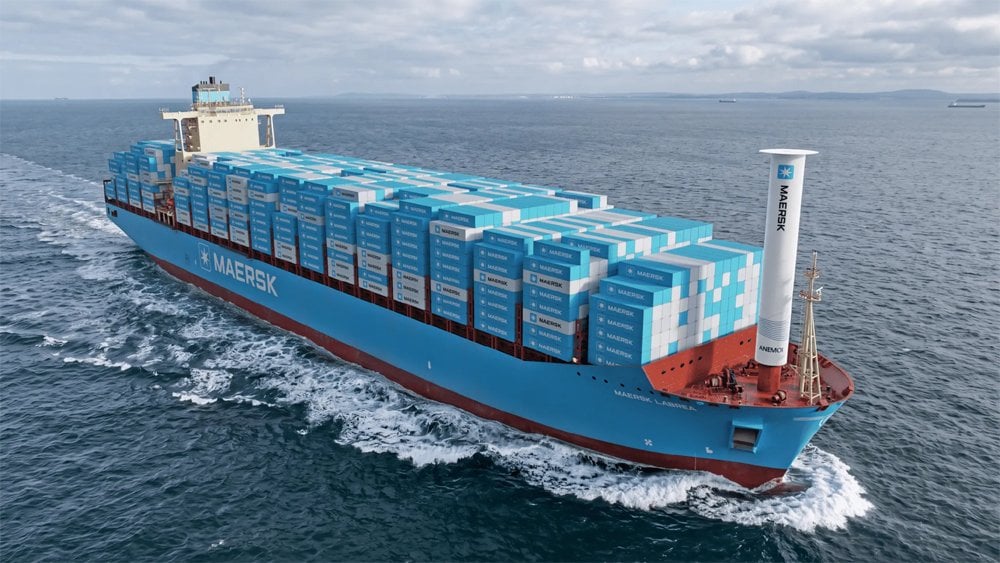
You’re right it’s supposed to work like a sail. I’m very sceptical because it says it can save up to 30% fuel. No chance any sail with that footprint can save that much fuel. At least with electrical generators you can benefit from wind in any direction at any time, even when anchored.
I’ve heard they work well. Something about the magnus effect produces thrust. I forget the details, but it doesn’t function at all like a traditional sail.
It’s more efficient than a sail of the same size, or they would’ve just installed a sail of the same size to reduce the moving parts.
AFAICT it’s more efficient because it acts like a plane wing/turbine blade with suction instead of literally just being blown on - basically, a turbine blade gets its speed from 1) being pushed sideways by the wind hitting the 45° plane, but also 2) the wind goes mostly over the rear of the wing, meaning there’s a high pressure at the back of the wing and a low pressure in front of the wing, which sucks the wing forward.
So this rotor sail uses the same suction trick, where the wind goes faster along the side that’s spinning with the wind and slower along the side that’s spinning against the wind, and the faster wind will have lower air pressure than the slower wind, thus sucking the rotor sail towards the faster wind side. But since the rotor sail is fixed to the ship, it sucks the entire ship forward.
The 30% fuel savings are pretty trivial, I could make it 80% if you give me a day and a sledgehammer to make the engine’s efficiency even worse. Maybe it’s running a two-stroke engine (not a marine two-stroke, just a regular two-stroke).