If c is correct for you then it’s also correct for those who answered at random. And if it is, then you’re all wrong because you’re answering about those who answered at random.
The only viable approach to actually answer is to argue that the question is ambiguous and that while the hypothetical test takers face infinite recursion you the real test taker don’t have to resolve the infinite recursion and to then choose a place to halt evaluation. And if they disagree then your solution to the Halting problem invoke the all powerful oracle function “I’ll talk to the principal”.
It’s not necessary to use recursion. Simple logic solves it. If a or c are true, that implies a and c are not true. If b is true, that implies b isn’t true. If d is true, that implies d isn’t true. No recursion needed and this is complete. You could take a recursive approach, but it doesn’t halt, like you said, so it doesn’t give a result.
(Also, the halting problem is determining if something halts, not what the value is at the end. This problem does not halt, if done recursively. The halting problem is easy to resolve for this particular problem.)


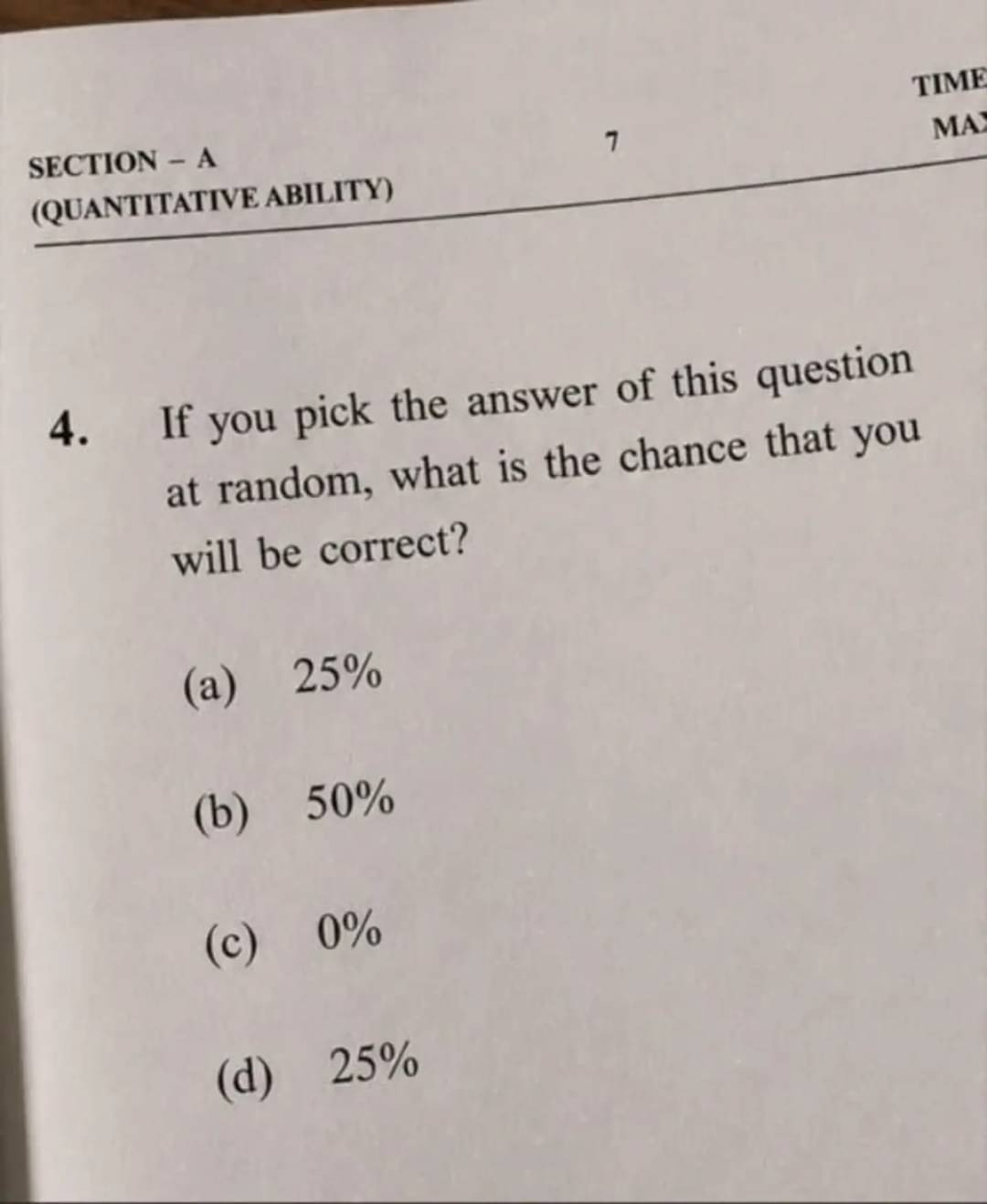
If c is correct for you then it’s also correct for those who answered at random. And if it is, then you’re all wrong because you’re answering about those who answered at random.
The only viable approach to actually answer is to argue that the question is ambiguous and that while the hypothetical test takers face infinite recursion you the real test taker don’t have to resolve the infinite recursion and to then choose a place to halt evaluation. And if they disagree then your solution to the Halting problem invoke the all powerful oracle function “I’ll talk to the principal”.
It’s not necessary to use recursion. Simple logic solves it. If a or c are true, that implies a and c are not true. If b is true, that implies b isn’t true. If d is true, that implies d isn’t true. No recursion needed and this is complete. You could take a recursive approach, but it doesn’t halt, like you said, so it doesn’t give a result.
(Also, the halting problem is determining if something halts, not what the value is at the end. This problem does not halt, if done recursively. The halting problem is easy to resolve for this particular problem.)