The correct answer is to leave all the options unmarked.
If you do pick an answer, then you didn’t do it randomly. When not marking the answers, the if-statement has the result of “false”, but that’s not the question.
If your teacher then asks why you didn’t answer it, you can safely and unparadoxically claim that inaction is also an option.
If “no answer” is in the set of possible answers, then it is not a correct answer because there’s then a 20% chance of it being picked at random. But usually that’s not the case for tests anyways.


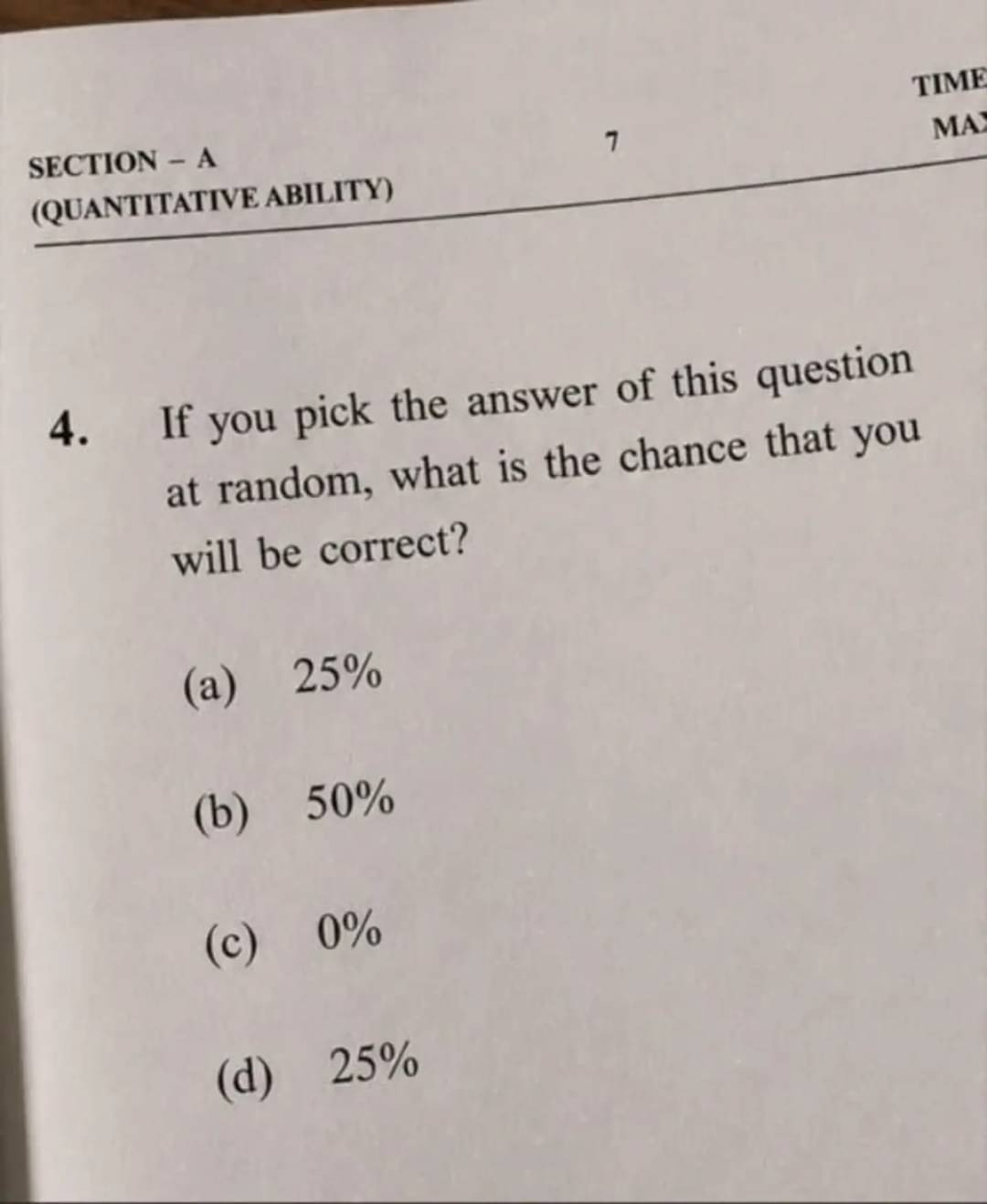
The correct answer is to leave all the options unmarked.
If you do pick an answer, then you didn’t do it randomly. When not marking the answers, the if-statement has the result of “false”, but that’s not the question.
If your teacher then asks why you didn’t answer it, you can safely and unparadoxically claim that inaction is also an option.
The question is not asking you to pick at random. It’s asking you to suppose that you do pick at random and to mark the correct answer not at random.
They aren’t asking them to pick an answer at random though.
If “no answer” is in the set of possible answers, then it is not a correct answer because there’s then a 20% chance of it being picked at random. But usually that’s not the case for tests anyways.
Severe programmer mentality 😂 I like it, but I doubt it would play out in the real world