I never even heard of an em dash until I started reading about AI. I was just using hyphens everywhere I was apparently supposed to be using em dashes. I am a stickler for grammar and correct punctuation (except for punctuation inside quotes which my internal programmer won’t allow me to do the American way) so I’ve started using em dashes – and now people think I’m an AI.
In the US, the punctuation is supposed to be inside of the quotes, even if that punctuation wasn’t actually part of what’s being quoted. So if somebody says “your mother sews socks that smell,” the quoted partial bit would be typed as “your mother sews socks.” In Britain it would be “your mother sews socks”. The difference might not be really obvious visually; it’s whether that period (which is required to end the sentence) is before the end quote or after it. Apparently programmers in the US (like I used to be) have gravitated towards the British style because with string variables (which are generally delimited by quotes) you can’t be farting around with adding phantom punctuation inside the quotes, even if it is grammatically correct here.
I’m I’m not mistaken, the reasoning for this goes back to the printing press era. The comma or period would be on the same type block as the quotation mark; dealing with individual blocks for , or " was too fragile or fiddly. So they had blocks for ," and ." that were used regardless of sentence structure


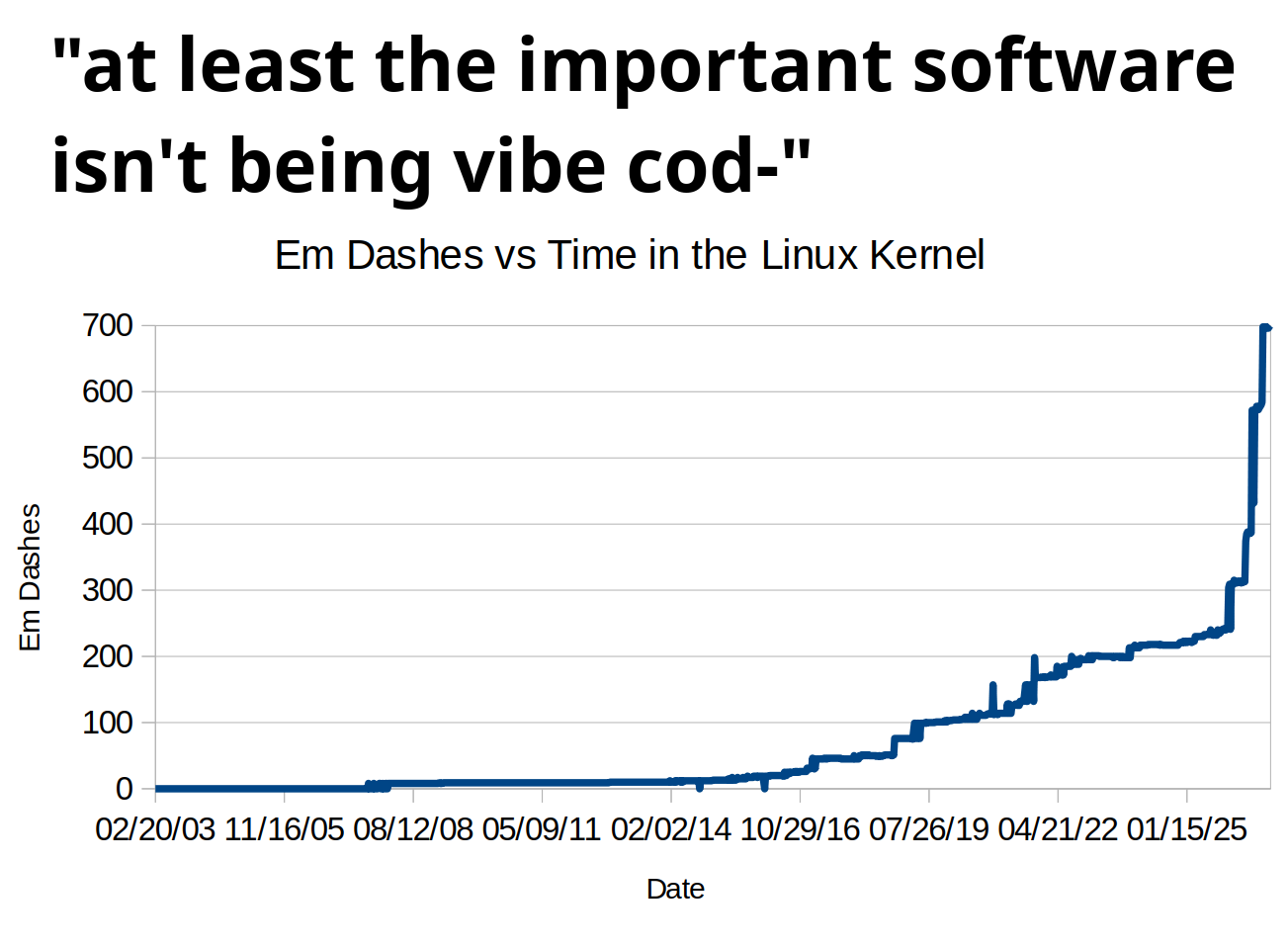
I never even heard of an em dash until I started reading about AI. I was just using hyphens everywhere I was apparently supposed to be using em dashes. I am a stickler for grammar and correct punctuation (except for punctuation inside quotes which my internal programmer won’t allow me to do the American way) so I’ve started using em dashes – and now people think I’m an AI.
That’s no —, it’s two hyphens playing pretend!
Some Markdown renderers interpret two dashes as an en dash and three as an em dash, so on some Lemmy clients, that might show up as a real en dash.
inb4 AI resurrects the tab v. spaces debates but between how many dashes equals an em dash.
Wait, what’s the rule for punctuation inside quotes? I don’t think I’ve ever noticed a regional difference.
In the US, the punctuation is supposed to be inside of the quotes, even if that punctuation wasn’t actually part of what’s being quoted. So if somebody says “your mother sews socks that smell,” the quoted partial bit would be typed as “your mother sews socks.” In Britain it would be “your mother sews socks”. The difference might not be really obvious visually; it’s whether that period (which is required to end the sentence) is before the end quote or after it. Apparently programmers in the US (like I used to be) have gravitated towards the British style because with string variables (which are generally delimited by quotes) you can’t be farting around with adding phantom punctuation inside the quotes, even if it is grammatically correct here.
I’m I’m not mistaken, the reasoning for this goes back to the printing press era. The comma or period would be on the same type block as the quotation mark; dealing with individual blocks for , or " was too fragile or fiddly. So they had blocks for ," and ." that were used regardless of sentence structure
Oh. That’s pretty neat. My favourite bit of typesetting lore :- this combination is known as the dog’s bollocks in some circles.