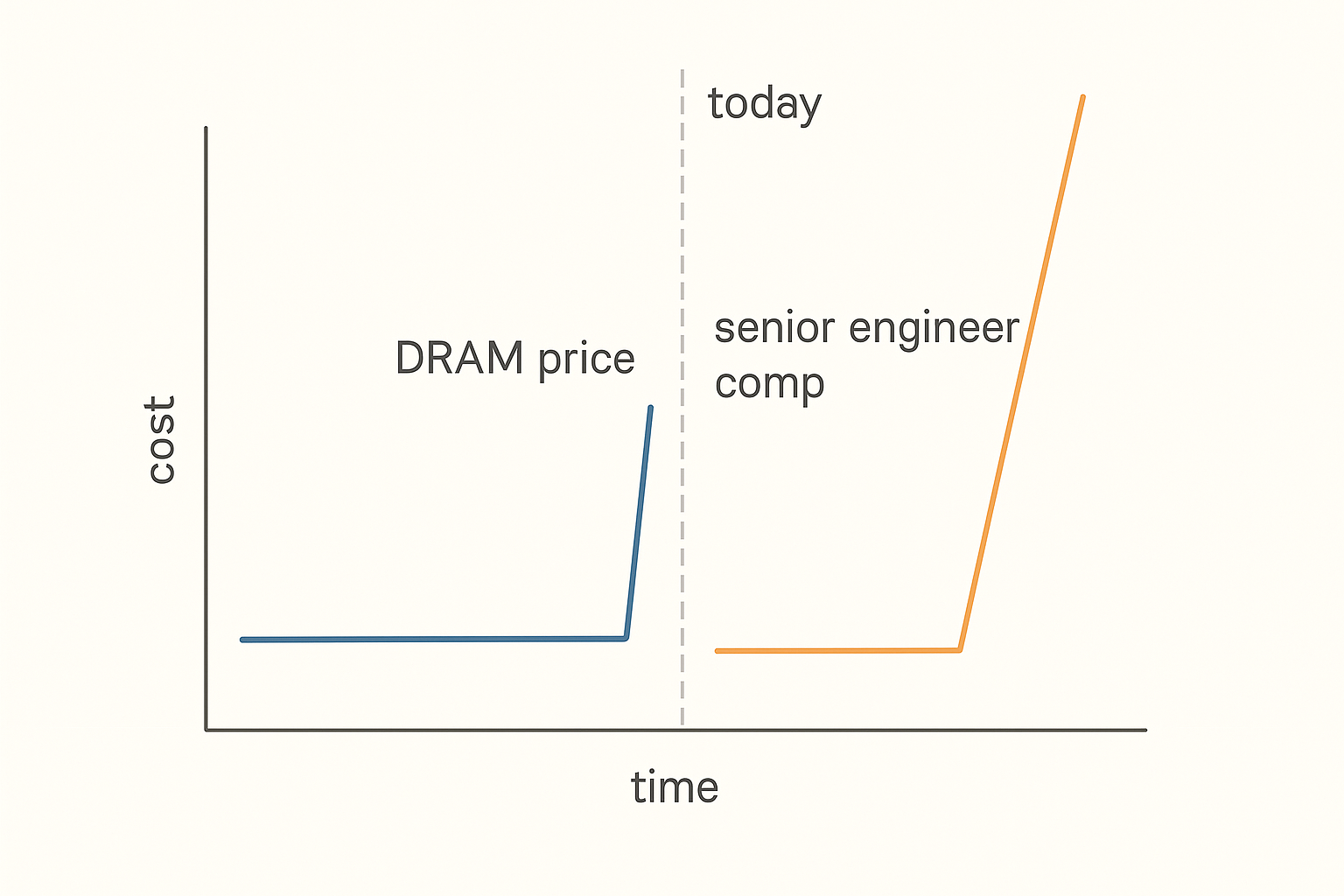
There’s a shortage coming that nobody’s put on a slide yet: senior engineers. Every company on earth is about to want one who can drive a fleet of agents with judgment — and almost nobody …
I tried reading the article, got about halfway through and it just keeps repeating the same thing over and over again. It starts with this:
There’s a shortage coming that nobody’s put on a slide yet: senior engineers. Every company on earth is about to want one who can drive a fleet of agents with judgment — and almost nobody is making new ones anymore, because AI ate the entry-level work juniors used to learn on
That’s it. That’s the whole article as far as I was willing to read. There’s almost no extra information further down. Holy hell.
Typical modern article. And then some people are going angry “You obviously have read only the title, not the article in full”. Wonder why people limit themselves only to titles? Maybe because the article is 2 sentences worth of data fit into 20 paragraphs of the life story of Jane Smith who was amazed and sat in awe after reading e-mail that will change her life?
Never read modern philosophy, but I had completely opposite experience with mid-late XIX century philosophy: too much words and too much repeating of the same thought from too many different angles. But I’m a technician type of guy so I might just have been unlucky with the set of authors. Never cared to read much of philosophy.
I tend to just look at the comments first here for anything even slightly questionable. Seems like some of the dumbed down shit does actual brain damage to read.
I think the consideration itself is valid. But Berts position has a big difference: He does not pretend that he can tell the future. It is quite logical and to expect that people ceasing to work as junior developers, or them not finding a job, might lead to a scarcity of senior developers. But we do not really know what happens. I’d describe it more as the whole field in crisis. And the jobs that remain, might not be the jobs that experienced senior developers, of which e.g. in Germany purely by demographics many are close to retirement, really want to do.
Something similar, at a perhaps smaller scale, has happened during and after the Corona pandemic in Europe in the field of hospitality: People in this sector could not get work, or only short hours. So they left the field, since there were other, better paying jobs, with more friendly work times. Hotels and restaurants experienced a worker shortage. One could have expected that then, the businesses had to pay more to attract people. But this did not happen at a significant scale. Was happened was automation and reduction of work, lowering of service standards, and restaurants closing. Was this predictable? I do not know.
Besides with software industry being pretty big, I think that the crisis may take another 50 years before having an effect they describe, not many of laid off now people will be able to wait for it


I tried reading the article, got about halfway through and it just keeps repeating the same thing over and over again. It starts with this:
That’s it. That’s the whole article as far as I was willing to read. There’s almost no extra information further down. Holy hell.
Yeah, that was probably the prompt. More or less. Then it’s padded with a mountain of slop.
When you use a LLM to expand two sentence to 5 paragraphs
Typical modern article. And then some people are going angry “You obviously have read only the title, not the article in full”. Wonder why people limit themselves only to titles? Maybe because the article is 2 sentences worth of data fit into 20 paragraphs of the life story of Jane Smith who was amazed and sat in awe after reading e-mail that will change her life?
Typical modern book as well. I keep reading classic philosophy just for being amazed at the amount of concepts crammed in under 100 pages.
Never read modern philosophy, but I had completely opposite experience with mid-late XIX century philosophy: too much words and too much repeating of the same thought from too many different angles. But I’m a technician type of guy so I might just have been unlucky with the set of authors. Never cared to read much of philosophy.
No, absolutely. At the very least from Hegel onwards, the game changes.
I read Stoics, the few things we have from Epicureans, Plato, Aristotle and Cicero’s work on rhetoric.
I tend to just look at the comments first here for anything even slightly questionable. Seems like some of the dumbed down shit does actual brain damage to read.
Bert Hubert wrote about the same consideration in a blog post.
I think the consideration itself is valid. But Berts position has a big difference: He does not pretend that he can tell the future. It is quite logical and to expect that people ceasing to work as junior developers, or them not finding a job, might lead to a scarcity of senior developers. But we do not really know what happens. I’d describe it more as the whole field in crisis. And the jobs that remain, might not be the jobs that experienced senior developers, of which e.g. in Germany purely by demographics many are close to retirement, really want to do.
Something similar, at a perhaps smaller scale, has happened during and after the Corona pandemic in Europe in the field of hospitality: People in this sector could not get work, or only short hours. So they left the field, since there were other, better paying jobs, with more friendly work times. Hotels and restaurants experienced a worker shortage. One could have expected that then, the businesses had to pay more to attract people. But this did not happen at a significant scale. Was happened was automation and reduction of work, lowering of service standards, and restaurants closing. Was this predictable? I do not know.
Besides with software industry being pretty big, I think that the crisis may take another 50 years before having an effect they describe, not many of laid off now people will be able to wait for it