

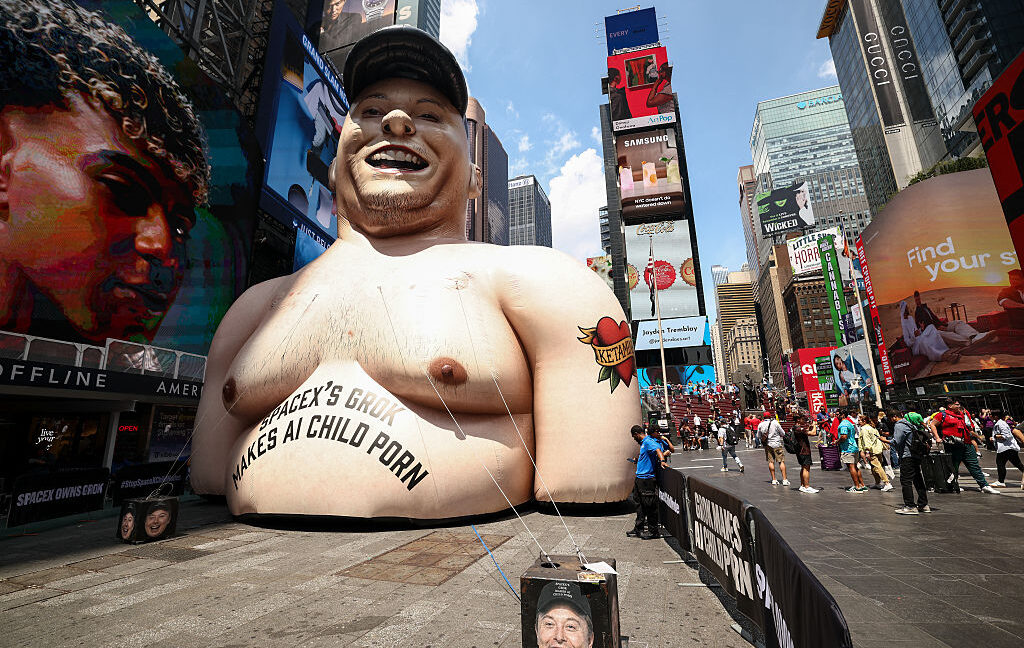
For her safety, Doe has opted to receive alerts from the US Department of Justice Victim Notification System any time she may be a victim in a new criminal investigation. Although she has received countless alerts, she was shocked when the CCCP notified her that it had identified AI-generated CSAM on xAI that depicted her. This re-traumatized Doe, whose complaint alleged that messages were found on online forums “between offenders chatting about creating AI generated CSAM of Plaintiff and other similarly situated known, legacy, victims of CSAM.”
Now, Doe fears that xAI has not only made it easier to make more violative images of the most distressing time in her life, but also that xAI allegedly has stored the images that Grok generates and uses those outputs to further train Grok. Because of this, she believes that Grok has been trained on both the initial set of images that have haunted her for more than 20 years and the more recent AI-generated ones.
This is the first case to accuse xAI of training on CSAM, and the complaint does not go into great detail on that claim. Previously, Ars reported on a controversial dataset that was later scrubbed after researchers found CSAM in the training data, but there’s no indication xAI trained on that data. In a press release from lawyers representing Doe, it explained that Doe’s images were included in a CSAM Hash List maintained by NCMEC, and “that same material” allegedly “was part of the dataset xAI used to build Grok’s image and video generating capabilities.” The complaint similarly only alleged that “CSAM depicting Plaintiff with its longstanding well-known hash values has been used as a part of the dataset used by xAI.”
I think there’s no real change that needs to be made to the law. The images are stenographically embedded into these models. There exists some generic input data that results in the reproduction of the embedded data.
This is not really any different than a password protected zip file.
Well, like I said, that comes down to whether, legally, that stenographic embedding would constitute “reproduction” or not. That’s what the German case hinges on. Obviously not relevant to US law, but a) a similar case could be made in the US, and b) X operates in the EU.
To play devil’s advocate, SpaceX would most certainly argue that what they’re doing is equivalent to storing a hash, like how Microsoft’s PhotoDNA system works. PhotoDNA can detect CSAM without storing CSAM because it only stores the image hashes, not the images themselves. So there’s pretty clear legal precedent for them to point to.
(NB: There has been work done by security researchers on reverse engineering images from hashes, so even that isn’t absolute.)
It’s a legally complex area where we’re likely to see case law evolving rapidly.
You can’t reproduce an approximation from any type of hash, so that argument is dead in the water.
Do you understand what I mean by stenographically embedded?
https://www.pseudodna.eu/. Scroll down to “Hash reversal” where they demonstrate the technique.
I took it to be an imperfect attempt to describe more broadly the way that data is mathematically encoded into LLMs.
Technically, stenography would require that the original be retrievable, since stenographic embedding is the process of concealing one thing inside another. Stenos, from the Greek “covered”. Personally, I’d argue that to conceal, you have to be able to reveal. If I throw a photograph into a fire I haven’t hidden the image in the fire. Modern stenographic image embedding techniques use methods of encoding data into another dataset without visibly altering the second set, with the intent being that that data can later be retrieved by someone who knows that it’s there (eg, least significant bit, where you change only the “1” bit of each pixel. This imperceptibly shifts the colour values of the image to a human viewer, but allows you to read out that stored data at a later time).
Now, since your argument rests on the exact opposite, that the data is not retrievable, I simply accepted the term as a “close enough” approximation for what I believe we’re both talking about - the extremely complex multidimensional data arrangement that forms the core of an LLM - and carried on from there because I find that sometimes it’s better to just roll with a person’s choice of language rather than quibble over it.
But since you clearly feel that your meaning was either improperly expressed, or improperly understood, you’re welcome to elaborate.
Wow they fucked that up so badly.
My understanding of hashing is a math function that reduces information.
The models and apparently that piece of software have retrievable information, so using that software to generate these images should count as reproduction under existing law.