
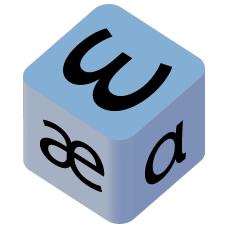
What’s the H supposed to be?
The Greek letter eta
deleted by creator
deleted by creator
I mean from my understanding h just describes multiple similarly produced sounds that never contrast in any language. In the case of arabic its a glottal fricative, in many languages its just a very strongly aspirated neutral vowel that assimilates to sorrounding vowels, or could work as a semivowel or aproximant or even somewhere between these. The point is even if the articulation is different, most speakers of most languages would categorize these as the same sound and there might even be a lot of allophony between them. Idk just my interpretation.
deleted by creator
Yeah and sadly the ipa isnt good for much more. You will get much farther actually describing a sound than just using ipa. In 99% of cases even pretty basic ipa usage is enough to describe most languages on a phonemic level and even to compare between languages with inventory for example but the reality is that our mouths are analog which means it can produce an infinite amount of different sounds within hard limits. If you “speak perfect ipa” and try to pronounce narrow transcriptions you will end up with an accent because youre not pronouncing the exact phones just their ipa approximation. Over all this means it still succeeds as there will not be any conflicts where one symbol describes two contrasting phonemes(tho you could argue there kinda are such situations but i couldnt bring up an example) its just that ipa isnt really meant to be used on an exact phone level. But yeah ipa politics is insane so people will kill eachother over these. Just look at ɧ, thats a clusterfuck.
deleted by creator
I mean you also make a convincing argument cause i think theres meny cases where a language has its own ides about whats a phoneme and what isnt, and the pretty artificial approach of “just looking at minimal pairs” is often pretty nitpicky. As for ɧ, there are three reasons for why it exists. First, sweden is very much a first world, western, rich country, so if they have a unique feature its going to have a high chance that its implemented in a standard. Second reason is the dialectal variation that you mentioned, in some dialects it reduces to quite simple phonemes like /ʃ/ for example. Third reason is that experts arent even really sure how its produced(yeah i know, wild). Like they literally dont know how its articulated. But yeah.
WAIT I FORGOR I NEED TO DO THE EXPLANATIONS FOR EACH CHARACTER XE8)
a, e, i, o, u: These ones are pretty self-explanatory.
b: is the symbol from canIPA for the sound between ɜ and ɐ.
c: is basically an uppercase U rotated 90 degrees clockwise.
d: is the IPA symbol for the open back rounded vowel.
f: is the Futhark rune Ansuz.
g: is the IPA symbol for the close-mid central unrounded vowel rotated 180 degrees.
h: is the Greek uppercase letter Eta.
j: fun fact: scribes used to use both i and j as the /i/ and /j/ sounds interchangeably, until Gian Giorgio Trissino came in and made it so that i is the vowel, and j is the consonant.
k: is the Phoenician letter 'ālep.
l: is a Latin capital letter Iota.
m: is the Futhark rune Ehwaz.
n: is the Cyrillic letter I.
p: is the Katakana symbol a.
q: is the Cherokee letter u, rotated about 135 degrees clockwise.
r: is the Cherokee letter e.
s: is the Urdu letter Ye.
t: is the Cherokee letter i.
v: fun fact: Romans used to use the letter V for their /u/ sound.
w: is a vowel in Welsh.
x: is the Hebrew letter Aleph.
y: it’s also a vowel smh
z: is the IPA symbol for the open-mid central unrounded vowel.
0: is the uppercase letter O.
1: is the uppercase letter I.
2: is the lowercase letter U mirrored, and turned 90 degrees counterclockwise.
3: same as Z :P
4: is the canIPA symbol for the rounded equivalent of ɪ.
5: is the Bopomofo letter o, mirrored.
6: is the canIPA symbol for the sound between o and ɔ, rotated about 45 degrees counterclockwise.
7: is the Shavian letter oil.
8: is the canIPA symbol for the sound at the midpoint of ɵ and ɒ.
9: is the canIPA symbol for the sound at the midpoint of ɵ and ɔ, rotated about 45 degrees counterclockwise.
~: is the aUI letter I, or “sound”.
!: is a lowercase letter I rotated 180 degrees.
@: is probably an open front unrounded vowel.
#: is two Ogham letter Onns stacked on top of each other.
$: is two lowercase letter E’s in the font “Morning Glory NF” shaped into a dollar sign.
^: is the aUI letter u, or “human”.
&: is a Greek letter Epsilon, with two dot shapes above and below it.
*: is the lowercase letter A in the font “Starborn”.
( ): are the Shavian letters egg and on respectively, both rotated about 45 degrees clockwise.
_: is the uppercase letter I rotated 90 degrees.
-: is a dotless letter I rotated 90 degrees.
+: is the Ogham letter Ailm.
=: basically - twice :P
{ }: are lowercase letter Y’s in the font “Suissnord”, both rotated to make each look like these symbols.
[ ]: are Bopomofo letter y’s, both rotated to their appropriated angles.
.: is the Braille letter A.
,: is the uppercase letter I, rotated about 45 degrees clockwise.
: ;: basically the previous two symbols combined to make these shapes
/: is the uppercase letter I, in italic.
: basically that mirrored
< >: same as ^, except each are rotated to their appropriated angles.
?: is the lowercase letter I in the font “Cedarville Cursive”, rotated 180 degrees.
CITATIONS: https://www.canipa.net/lib/exe/fetch.php?media=docs%3Anpt-ch-07-14_2023-07-20_main.pdf https://en.wikipedia.org/wiki/International_Phonetic_Alphabet_chart https://en.wikipedia.org/wiki/Elder_Futhark https://en.wikipedia.org/wiki/J https://en.wikipedia.org/wiki/Phoenician_alphabet https://en.wikipedia.org/wiki/Latin_iota https://en.wikipedia.org/wiki/Cyrillic_script https://en.wikipedia.org/wiki/Katakana https://en.wikipedia.org/wiki/Cherokee_syllabary https://en.wikipedia.org/wiki/Urdu_alphabet https://en.wikipedia.org/wiki/U https://en.wikipedia.org/wiki/Welsh_orthography https://en.wikipedia.org/wiki/Hebrew_alphabet https://en.wikipedia.org/wiki/Bopomofo https://en.wikipedia.org/wiki/Shavian_alphabet https://en.wikipedia.org/wiki/AUI_(constructed_language) https://www.internationalphoneticassociation.org/sites/default/files/extIPA_2021.pdf https://en.wikipedia.org/wiki/Ogham https://www.myfonts.com/collections/morning-glory-nf-font-nicks-fonts/ https://www.dafont.com/starborn.font https://www.1001fonts.com/suissnord-font.html https://en.wikipedia.org/wiki/Braille https://fonts.google.com/specimen/Cedarville+Cursive
deleted by creator
Go look here for context: https://www.internationalphoneticassociation.org/sites/default/files/extIPA_2021.pdf
deleted by creator
thx u for understanding ε’=


![[REUP FROM REDDIT] Uh... I guess that's one way to do it...](https://thelemmy.club/pictrs/image/f07672f8-34e4-4220-9661-cc5826fe5b3a.gif)