

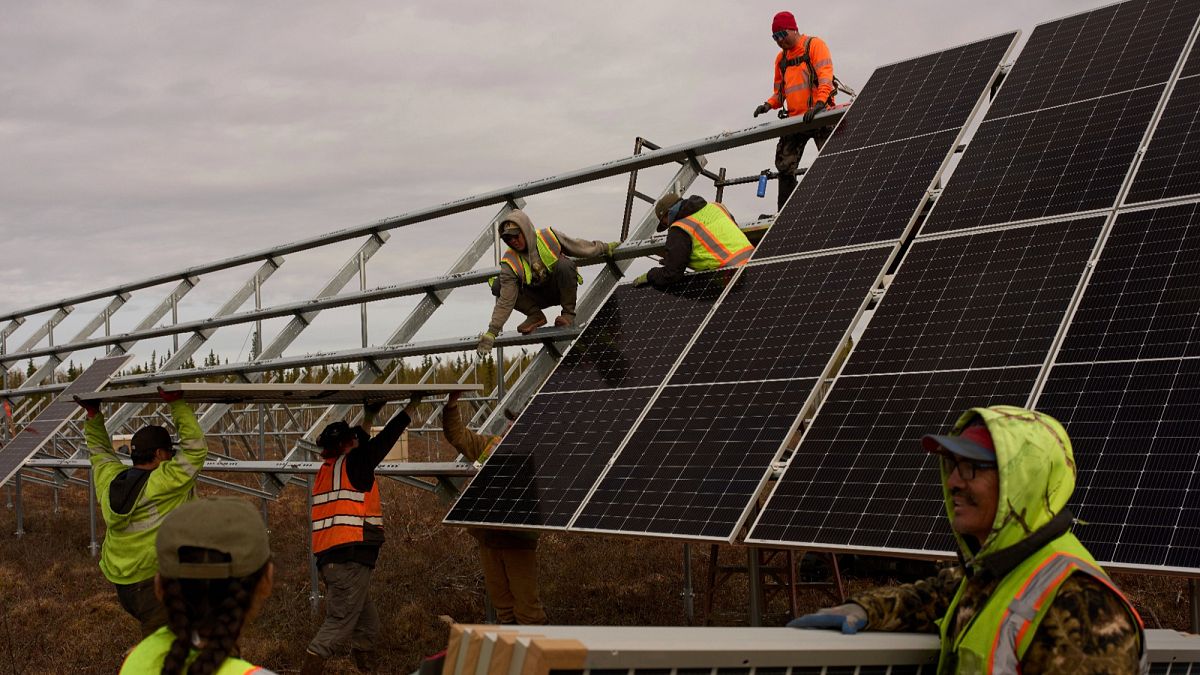
Solar can’t be owned by people and not be completely controlled by a huge company. Solar is decentralized energy and it needs to be embraced way more
The production of solar panels and mineral can be controlled by groups. It’s not as decentralized as we think, but still better than oil, nonetheless
As well as the permitting policies, tarriffs, and fees for grid-connected solar systems. At least where I am (California), governments and utilities have made solar much more expensive than it needs to be.
Solar can’t be owned by people and not be completely controlled by a huge company.
Think you accidentally added an extra 't
It doesn’t matter as long as Big Oil controls policy. Can’t fucking wait for Big Solar to displace them in terms of political influence.
How do you even compare something that generates energy for decades and can then be recycled and generate energy for further decades vs something that you use once and then it’s gone forever?
https://en.wikipedia.org/wiki/Levelized_cost_of_electricity
calculate total costs of power plant + fuels over the power plant’s lifetime, divide by total kWh produced --> that gives you the average cost per kWh.
it is key here to see that even if solar panels produce energy over and over again, they still have a finite lifetime so they only produce a finite amount of energy per panel. so you can still calculate the cost per kWh by dividing panel cost by total kWh produced. the result then is non-zero because total kWh produced is not infinite.
By price, obviously!
/s (but a little bit not /s?)
I mean, sure, but it’s comparing $ per kWh vs $ per kW
Edit: To be clear, I do understand that consumer pricing is kWh across the board. My point is that the producer side for solar doesn’t actually scale per hour the way it does for fossil fuels. So while $/kWh is a convenient metric to shove renewables into the existing market, it kinda stacks the deck in favor of fossil fuels.
(Total cost of install + total expected maintenance + fuel costs) / expected lifespan
Then divide that by kwh or mwh or GWh expected to be produced during that lifespan
The catch is that solar is outliving the expected lifespan estimated and warranty periods which means things still tilt towards legacy fuels (doesn’t tip enough in their favor to make them less expensive though)
Guterres also pointed out that fossil fuels still get almost nine times the government consumption subsidies as renewables.
The problem, as always, is not the technology but the politics.
I’ve always been supportive of solar. After all, if the Sun goes out, we got bigger problems than charging our cell phones.
I’ve had many, many people over the years tell me it’s too expensive, not efficient enough, etc., and I always said that research will fix all that, and someday it would work great, AND be economical. I never figured it would be because Trump would fuck up the energy economics of the entire planet, and solar would suddenly be the best choice.
I don’t think it was even a matter of research, or it least it hasn’t been for a while, more it’s a matter of scaling production and competitive supply chains.
If there are 15 steps to produce a panel and you need to make 20% profit to pay off the capital expense and cover fixed costs, then the final product is going to be expensive, if the scale is large enough to afford to only make 1% profit at every step things get cheap.
Will nations finally see what a geopolitical risk oil is?
Cheaper, takes up less space, and isn’t consumable, but worse because…uh…
You ain’t seen nothing yet
Then why is it more expensive when I opt to use renewable (including solar) energy with the electric company?
Oh wait, that’s because none of them actually want people to use it because they make less from it and/or are already so invested in fossil fuels that they don’t want to lose money on their investments so they jack up the costs intentionally to dissuade people from using it.
That’s just my opinion on the matter, I don’t have the data to back it up outside of the electric company here giving you the option to enroll in renewable energy at a higher cost.
Because energy companies are notoriously corrupt the world round.
Renewable energy is “new” for them, so they charge a premium because they know people will pay it even though it is cheaper and it makes them more profit.
Epstein-class garbage in charge of most energy companies.
Euronews has Orban ties.
But gas is also more profitable than ever for those involved. Any increase in price gets passed along to down stream consumers, but the margins have increased.
And since the people deciding what electrical generation are getting put in are not the ones paying the final bill, they have no reason to pursue solar at scale.
Some places are installing it at scale, but it’s almost always due to some public mandate, or because the people putting it in are the ones paying for the final power.